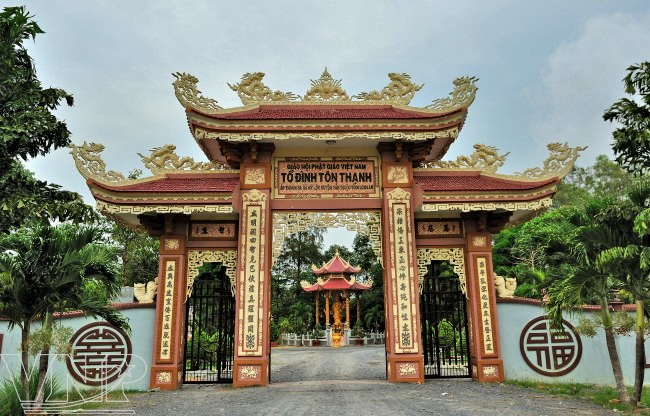
Located about 5km from the center of My Tho City, Tien Giang, Dong Tam Snake Farm is dubbed the “kingdom of snakes” in Vietnam, housing more than 400 species of snakes.
Whether you are a snake lover, someone who is afraid of them, or even someone who dislikes them, you should visit this kingdom at least once to admire the wonderful world of these legless reptiles.
Dong Tam Snake Farm is the familiar name used by locals, while its official name is the Center for Cultivation, Research, and Processing of Medicinal Plants of Military Region 9, located in Binh Duc Hamlet, Tan Thuan Commune, Chau Thanh District, Tien Giang Province.
With an entrance fee of 25,000 VND for adults and 15,000 VND for children, you can step into an entirely different world—the world of snakes. First, visit the screening room to hear an introduction to this special snake-raising center. Dong Tam Snake Farm was established in 1979 under the initiative of Lieutenant Colonel Tran Van Duoc. As a man of profound knowledge and a passion for snakes, Lieutenant Colonel Duoc wanted to build a diverse snake farm to produce anti-venom serum and contribute to snake venom exports.
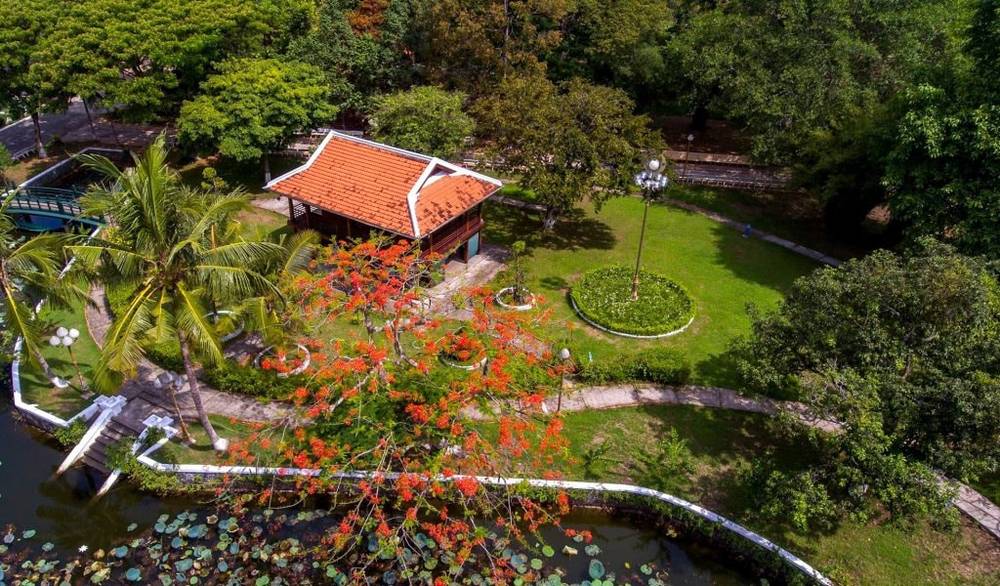
Set within a cool 30-hectare space shaded by tall ancient trees, this is a unique and attractive ecotourism site. Coming here, you feel like you’ve entered a “chilling labyrinth,” yet it is fascinating—a world consisting solely of snakes.
Dong Tam Snake Farm is divided into three areas for housing reptiles. Following the guide, visitors step into a novel world that piques curiosity about animals often considered terrifying and dangerous.
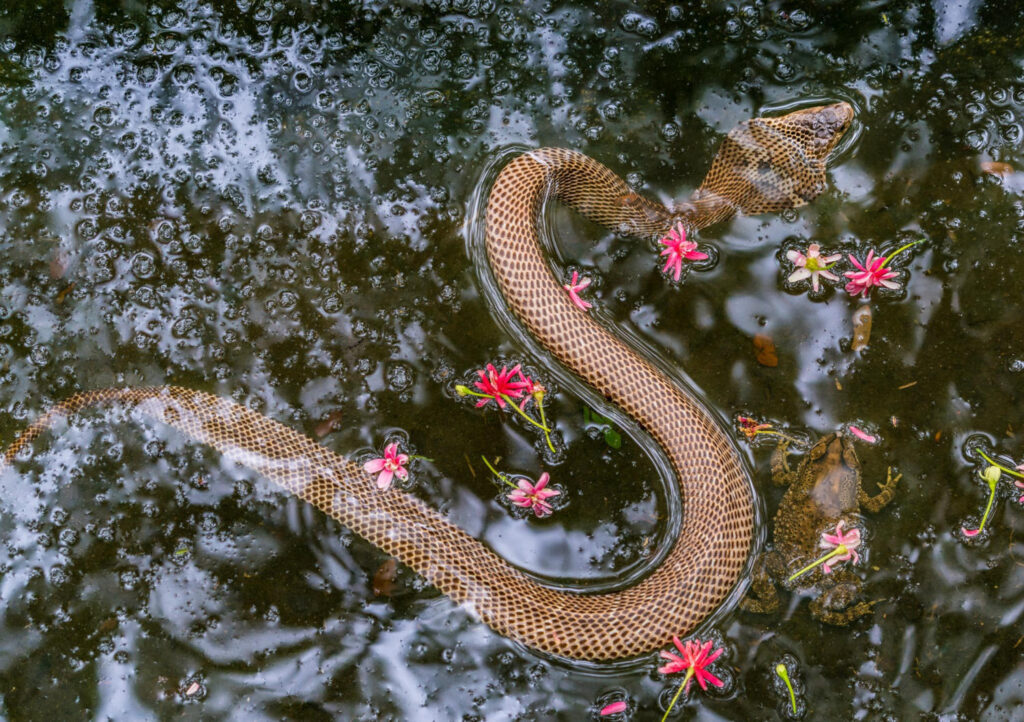
The first is the island-style lake area, surrounded by chest-high walls with a single entrance. Inside, the lake bed is about 30–40 cm deep and filled with shallow water. In the middle of the lake is a small island with lush grass, serving as a shelter for toads, frogs, and bullfrogs—the primary food source for the snakes.
The small island has several clumps of green trees as tall as the lake walls. On the foliage, snakes can be seen crawling in clusters. At first glance, anyone might feel a mix of fear and confusion due to the close proximity to the snakes. However, do not worry, as experts have carefully calculated everything so that the snakes cannot leap from the canopy over the walls.
Using a long metal pole with a hook at one end, the guide gently hooks a snake and brings it toward the visitors to introduce its biological characteristics and compatible activities. It is quite exciting, as there are few opportunities to get this close to a reptile considered quite dangerous.
Passing by the lake enclosures one by one, visitors gain a deeper understanding of various snake species, such as green pit vipers, copperhead racers, water snakes, elephant trunk snakes, and file snakes… these are gentle, non-venomous types.
Leaving this area, you enter the venomous snake section, which houses species like the radiated ratsnake, banded krait, and Malayan krait… Most notably, the King Cobra—an extremely venomous snake ranked “E” (Endangered) in the Red Data Book of Vietnam. They are kept in separate individual cages.
Raising these fierce snakes is a feat full of danger. When opening the cage doors, keepers must be extremely careful, gentle, and slow to prevent a hungry snake from lunging out or biting. Caring for snakes is much like caring for a child; keepers must monitor them constantly to promptly detect any signs of illness for timely treatment.
The center has several hundred King Cobras; one King Cobra eats 1.5 kg of assorted snakes per meal. They are fed twice a week. Common cobras, however, only eat toads, frogs, and mice. Therefore, during the dry season, the center must store large amounts of food—even tons in freezers—to feed the snakes gradually.
Additionally, the center also raises crocodiles, turtles, foxes, bears, peacocks, ostriches, porcupines, monitor lizards, and yellow-cheeked gibbons…
At the snake farm, visitors will hear stories of many near-death snake bite cases that were saved thanks to the anti-venom serum. These thrilling stories, which seem impossible, have actually happened here. Since its founding, the Center has successfully treated numerous snake bite victims, with no fatalities recorded.
Extracting snake venom is an elaborate process, with each extraction yielding only 1 to 2 drops of venom per snake. Each year, a snake only provides about a dozen drops. Just 10 grams of snake venom can be used to prepare enough serum to serve the entire country’s needs for a year. However, a mere 1 gram of snake venom is potent enough to kill 165 people with an average weight of 60 kg!
Visiting Dong Tam Snake Farm means visiting the first snake museum in Vietnam. This museum was certified by the Vietnam Records Organization as the country’s first snake museum, preserving the most snake species in Vietnam with over 40 characteristic species from the Mekong Delta. Most notably among them is a 17-year-old King Cobra, 4.2m long and weighing 18kg.
Every animal has its own beauty. While snakes are dangerous in the imagination of most people, a visit to Dong Tam Snake Farm will surely change your perspective. There are many gentle, non-venomous species… and even for the highly venomous ones, if we know how to utilize them, they are beneficial to humans. The world of snakes remains a mysterious realm that warrants our exploration.
According to Can Tho Newspaper