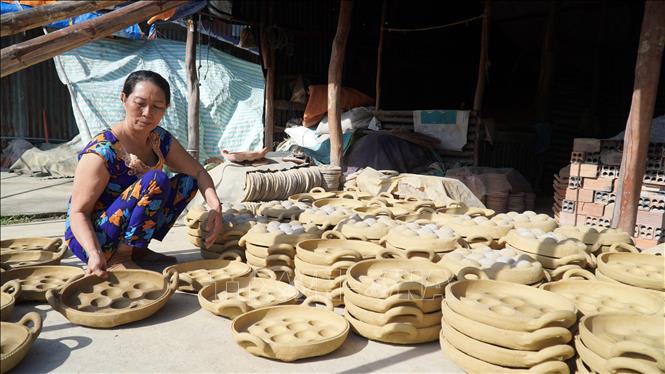
When mentioning mats, people in southern Vietnam often think of the once-famous Cà Mau mats. However, there is a traditional craft village that has created a mat brand no less renowned than Cà Mau mats, namely the traditional mat-weaving village of Long Định Commune (Châu Thành District, Tiền Giang Province).
For those who have ever visited Tiền Giang and traveled along National Highway 1, about ten kilometers from the Trung Lương intersection, they will surely notice a large sign reading: “Long Định Traditional Mat-Weaving Village Welcomes You!”
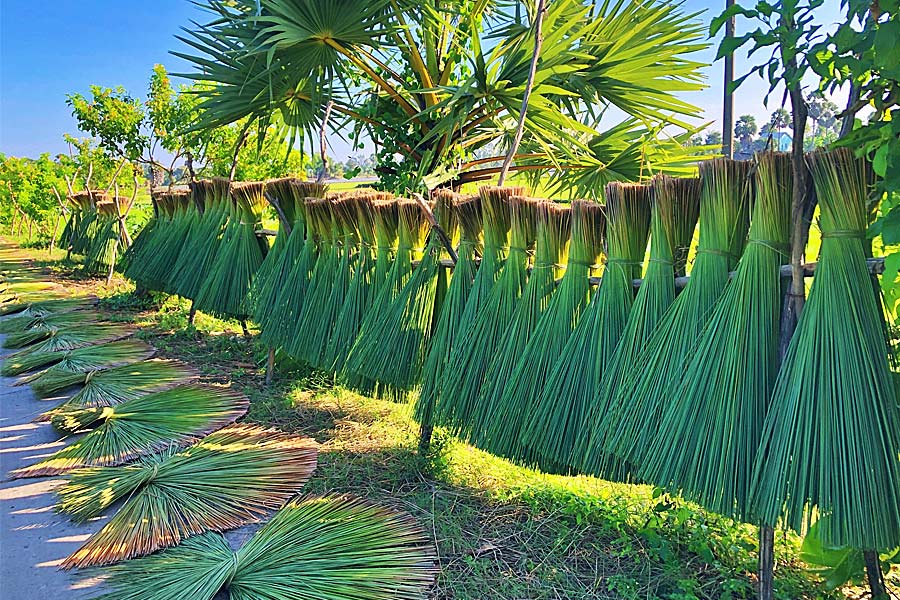
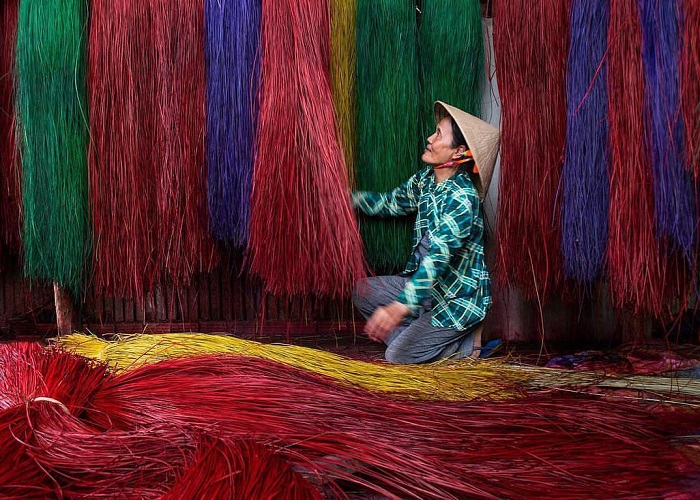
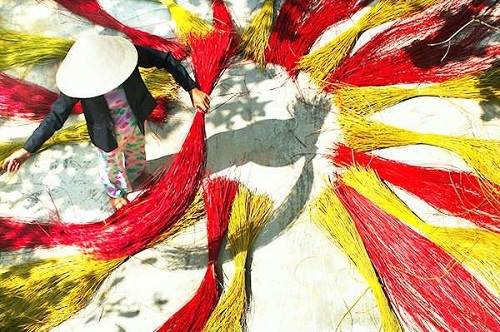
From the location of that sign, turning onto Provincial Road 867 and traveling about half a kilometer leads to Long Định Village. From the entrance of the village, one can already see mats and sedge grass drying along both sides of the road. Bundles of ivory-white sedge grass or those dyed green, red, purple, yellow, and other colors are laid out to dry under the golden summer sun. Going deeper into the village, the rhythmic clatter of shuttle looms weaving mats can be heard everywhere.
The mat-weaving craft in Long Định has existed for just over 50 years. It was introduced by migrants from Kim Sơn, Ninh Bình Province in northern Vietnam—an area famous for mat weaving—who moved south in 1954. Therefore, the weaving techniques here differ in many ways from those commonly seen in the South. Long Định mats are always thicker, with brighter colors and more attractive patterns.
Visiting the traditional mat-weaving village of Long Định, it is easy to see mats drying along Provincial Road 867 in front of nearly 300 households in Long Định Commune. The craft has created jobs for nearly 2,000 rural workers, helping them earn a stable income.
In each house along Provincial Road 867, weaving frames sway rhythmically with the movement of the shuttle. In one house, two young women work together; in another, a husband and wife—one arranging the sedge strands, the other operating the loom. Stopping by the home of Mr. Nguyễn Văn Việt, we see him and his wife tightening the straps and then sitting together to weave, creating beautiful products for everyday life.
Mat weaving, like rice farming, depends greatly on nature and weather. Every year, during the dry season—from around January to April—the Long Định mat village enters its main production period. The most difficult months are May and June, when the rainy season arrives and mat production must pause until the next dry season. Despite these hardships, Long Định artisans remain devoted to their craft, as mat weaving still provides a better income than rice farming.
After preparing the materials, mat weaving usually requires two people working together. Typically, once the straps are tightened, the main artisan sits at the loom while the second person feeds each sedge strand into the frame. The main artisan then applies strong force to press and bind the strands tightly together.
The pressing motion must be firm and decisive, with enough strength to keep the sedge strands straight and evenly aligned without overlapping. “The skill of the artisan is extremely important,” Mr. Việt shared. “You have to weave in a way that makes the mat tight, even, and durable. Only then will the mat last a long time.”
With swift and powerful movements on the loom, Mr. Việt continued chatting cheerfully with us: “With a manual loom, the two of us can weave four mats a day. If we had a modern mat-weaving machine, it could produce up to ten mats a day with just one operator.”
“However, a modern mat-weaving machine costs between 30 and 60 million VND, which is too expensive for us to invest in at the moment. Moreover, many customers prefer handwoven mats because they are more durable and have fewer defects than machine-woven ones.”
One of the most well-known mat-weaving families in Long Định is the family of Mrs. Trần Thị Bạch Tuyết. With 50 years of experience in mat weaving in Long Định Commune, she shared that in the past, when mats were woven entirely by hand, one person could earn about 1.5 million VND per month. Today, with investment in weaving machines, productivity has increased significantly, resulting in much higher incomes.
Long Định mats are famous for being thick, durable, comfortable to lie on, and well-ventilated. Their prices are suitable for consumers, so traders from many places come daily to purchase them. At peak times, the mat village thrived, delivering more than 5,000 mats per day to traders. Moreover, Long Định mats are also exported to markets such as South Korea, Japan, and the United States.
To produce a beautiful mat, the sedge grass must be thoroughly dried, white, glossy, round, and not too thick. Weaving technique is the decisive factor in determining a mat’s quality. During weaving, the person feeding the sedge must have good technique and work evenly to avoid losing rhythm.
The coloring process is also very meticulous. To ensure that the color does not fade or stain clothes when used, the sedge strands must be dipped into boiling dye, then allowed to boil again so the color can fully penetrate each strand. “Especially during sewing, the stitches must be sharp and neat—not too dense, nor too sparse,” Mrs. Tuyết shared her experience.
Currently, in addition to traditional sedge mats, artisans in Long Định Commune have also researched and produced mats made from dried water hyacinth stems—a material commonly found in the waterways of the Mekong Delta. However, water hyacinth mats are much more expensive than sedge mats, so they are rarely used domestically and are mainly exported abroad.
Decorative patterns must be frequently updated to match consumer preferences. After the patterns are completed, the mats must be steamed. The steaming time must be precise: if overheated, the mat will darken; if under-steamed, the color may fade during use.
Compiled by Băng Tâm