Among the tourist attractions in Châu Đốc, Núi Ba Thê in An Giang is always mentioned, as it is a picturesque landscape that captivates countless visitors.
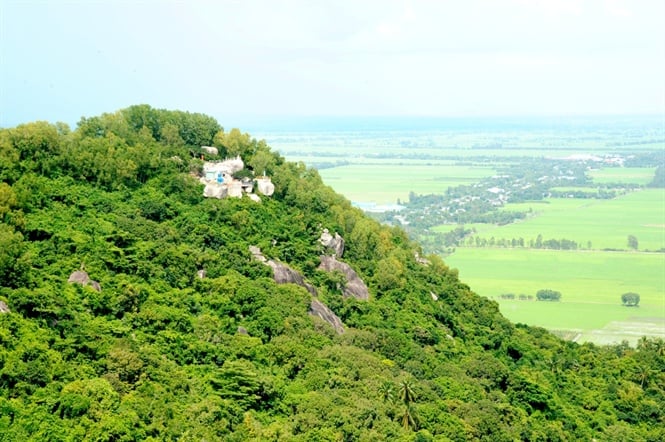
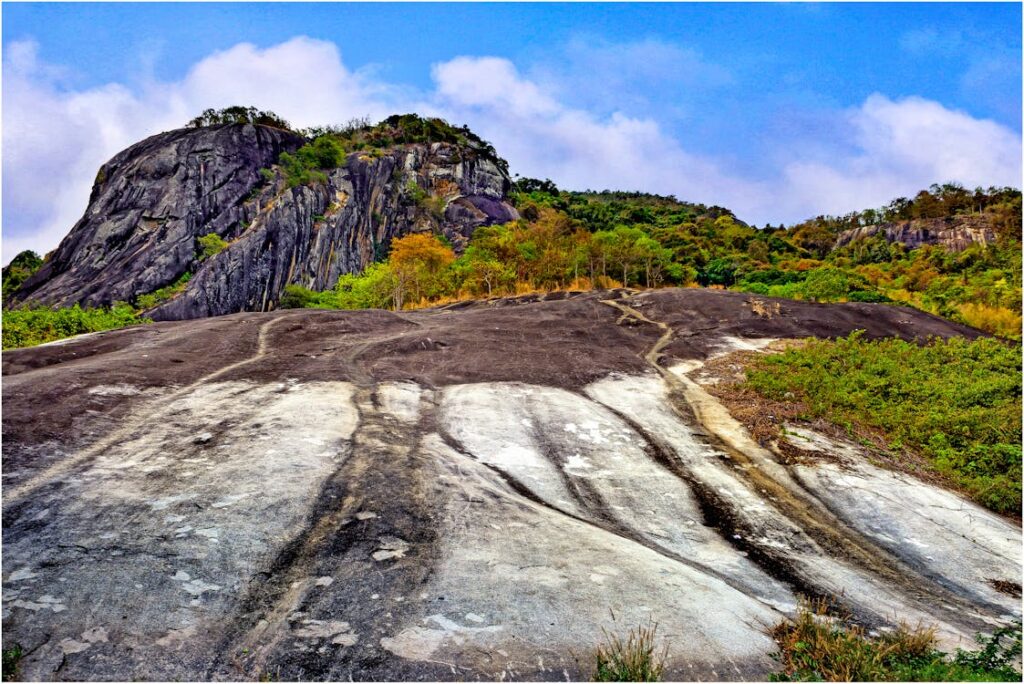
Núi Ba Thê, also known as Vọng Thê, originally called Hoa Thê Sơn, was renamed during the Nguyễn Dynasty due to name taboos. It is an isolated mountain standing alone in the Long Xuyên Quadrangle plain, now located in Óc Eo Town, Thoại Sơn District, An Giang Province. Núi Ba Thê is commonly used to refer to the cluster of mountains including Ba Thê, Núi Nhỏ, Núi Tượng, Núi Trọi, and Núi Chóc. Ba Thê Peak is the highest, rising over 200 meters. It would be incredibly exciting if your trip here is a “phượt” (adventure/backpacking) journey.
It was quite strenuous and dangerous when we climbed Núi Ba Thê on a motorbike, crawling up in first gear with great difficulty. On one side was a sheer cliff, on the other a deep green abyss filled with towering ancient trees. There are quite a few restaurants and eateries lined up along the mountainside. According to our guide: “It’s manageable in the dry season, but in the rainy season, don’t risk riding up here—the road becomes extremely slippery. Local motorbike taxis have to reinforce their engines, change sprockets and chains just to make it to the top…”.
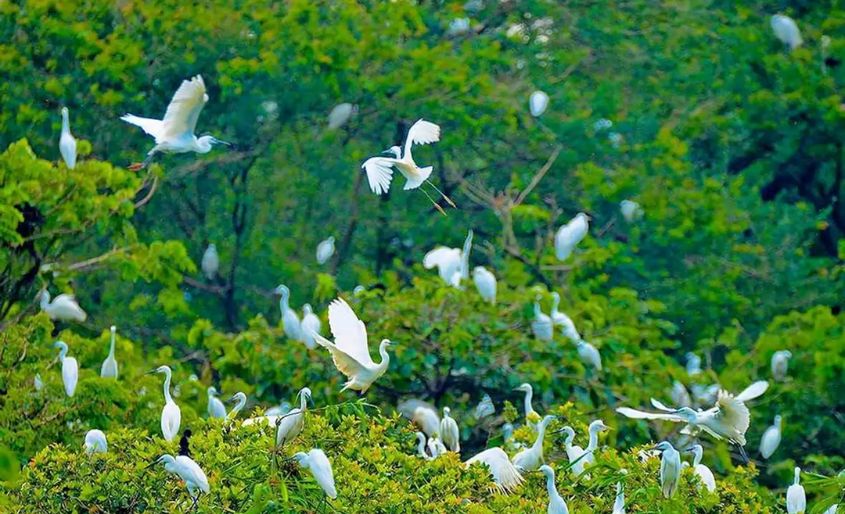
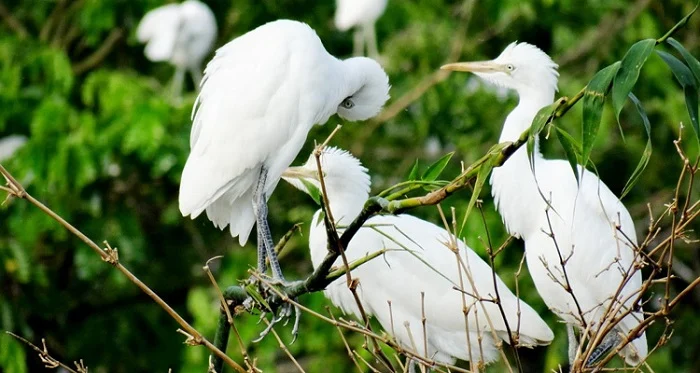
To the west of the mountain lies the poetic and romantic Thoại Hà River. In front, it borders vast swamps, dense grass, and muddy terrain. Legend has it that in ancient times, Lord Thoại Ngọc Hầu ordered the river to be widened for easier boat traffic and trade. Many locals living around the mountain also recount that this area once had leopards, elephants, and many rare animals; now only monkeys, forest birds, squirrels, herons, and ground cuckoos remain…
When visiting Núi Ba Thê, tourists are treated to a breathtaking natural wonder bestowed by creation. Standing at the summit, you can take in a panoramic view of the entire area. Surrounding the mountain are vast fields stretching endlessly; far to the west lies the Rạch Giá sea area, and slightly southwest, the majestic Thất Sơn mountain range stands on the horizon.
At the foot of the majestic Núi Ba Thê stands Linh Sơn Cổ Tự, also known as the Four-Handed Buddha Temple—a famous historical and cultural relic that attracts many visitors and devotees. The temple is situated on a high mound within a 10,000 m² compound. Along the paths and throughout the temple grounds are centuries-old giant trees providing abundant shade. There are many legends about how the Four-Handed Buddha statue was brought here for worship, but perhaps the most widely accepted is the story told by the 85-year-old abbot of Linh Sơn Temple, Venerable Thích Thiện Trí.
The story goes that in 1912, when the French mobilized locals to demolish a mound for building a military post, they discovered a Four-Handed Buddha statue over 1.7 meters tall made of fired clay buried about 2 meters deep. At that time, over 80% of the local residents were Khmer, so they planned to bring the statue to a Khmer temple. Strangely, even with dozens of strong young men, they could not lift it. The next day, the abbot of Linh Sơn Temple prayed to bring the statue to his temple. Immediately, only about four people were able to easily carry it on a wooden litter back to the temple. Whatever the case, it remains a miraculous tale.
What remains mysterious to this day and has no satisfactory explanation is that in the temple courtyard today, there are two very large stones facing each other, one engraved with ancient script. When the Four-Handed Buddha statue was brought back, it fit perfectly into the gap between these two ancient stones. The main hall of the temple was built exactly in that spot and remains so to this day.
On December 6, 1989, the Four-Handed Buddha statue and the two ancient stones were recognized as a national cultural relic. The Vietnam Records Center also recognized the statue and the two ancient stone steles as having the oldest historical dates. Additionally, at the foot of Núi Ba Thê, there is a đình (communal house) dedicated to Phan Thanh Giản.
On Núi Ba Thê, there is also a giant footprint that locals reverently call “Bàn Chân Tiên” (Fairy’s Footprint). Here, people built the ancient Sơn Tiên Tự Temple in 1933. The temple houses a precious stone stele recording the historical event on May 6, 1968, when a special forces team led by comrade Nguyễn Văn Muôn eliminated 29 enemies at the summit of Núi Ba Thê, causing panic and forcing the enemy to withdraw.
Near the summit stands the massive Đại Đao Tower. Legend says that long ago, a huge stone shaped like a sword suddenly appeared. After several days and nights of a fierce storm, the stone split open, revealing a large sword inside. From then on, people built a tower to protect the sword from rain and sun damage, serving as a place for worship.
About 10 meters from Sơn Tiên Temple is the Óc Eo – An Giang Cultural Artifacts Exhibition House. This structure features architecture bearing the imprint of Hindu culture. To the north of Núi Ba Thê, there are also Ông Hổ Cave, Ông Tà Peak, and places of worship for the Mountain God…
Standing on the majestic slopes of Núi Ba Thê, enjoying the refreshing breezes, gazing at the green expanse of mountains and forests, then looking out toward the villages, seeing endless rice fields stretching far away and glimpses of peaceful small houses—this is when you truly feel the ultimate allure of the famous Núi Ba Thê.
According to Báo Cà Mau