There is a sightseeing destination in Cần Thơ that visitors to the Mekong Delta should not miss: the ancient house of the Dương family, also known as the Bình Thủy Ancient House.
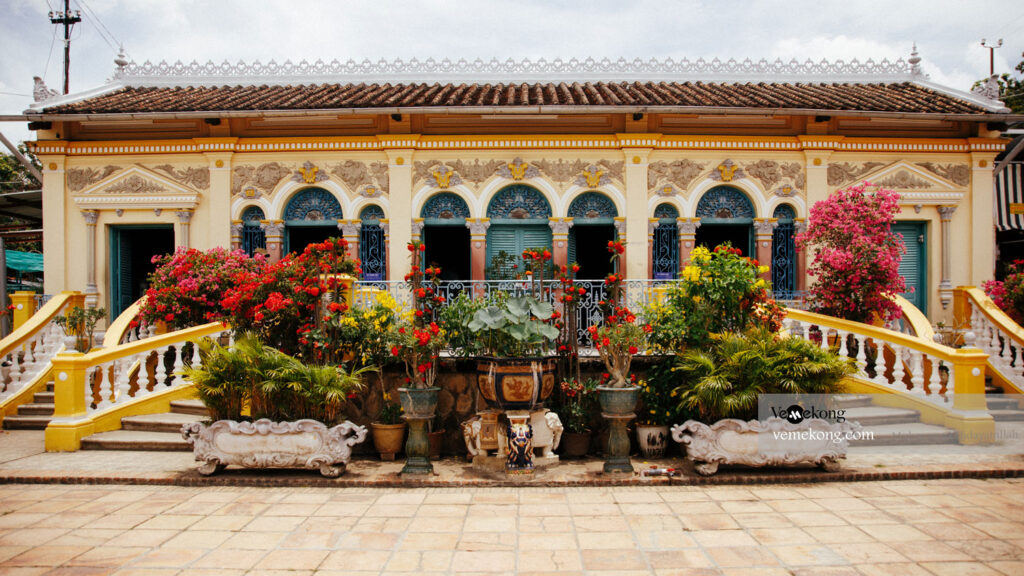
The Bình Thủy Ancient House, featuring five compartments and two roofs, was built by the Dương family in French architectural style nearly 150 years ago and remains remarkably well preserved. This site is also known as the Bình Thủy Orchid Garden, as the fifth-generation descendant who grew up in this house, Mr. Dương Văn Ngôn, had a passion for ornamental plants and cacti. In the 1960s, Mr. Ngôn collected many rare orchid varieties and began organizing orchid clubs. In the 1980s, he combined this hobby with welcoming tourists to visit the ancient house, creating opportunities for like-minded people to exchange experiences, appreciate flowers, and compose poetry together. Today, the sixth-generation descendant, Mr. Dương Minh Hiển, along with his family, continues to inherit and preserve the house.
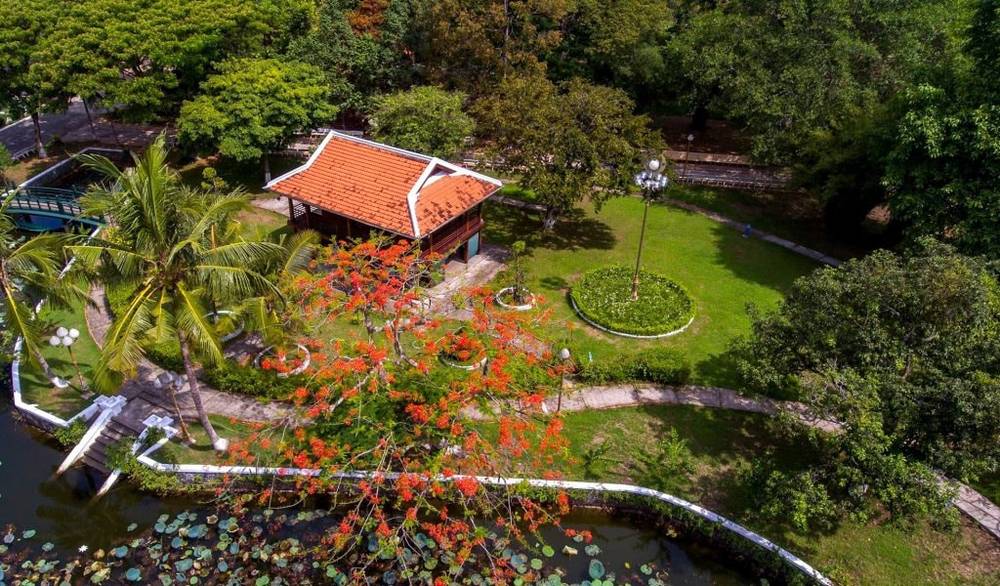
The Bình Thủy Ancient House consists of five main compartments and two side wings, measuring 22 meters in width and 16 meters in depth, situated on a 6,000 m² plot of land. In front of the yard are rockeries and ornamental plants. To the right is an orchid garden, while on the left corner stands a Mexican columnar cactus (Kim Lăng Trụ) about 8 meters tall and approximately 40 years old. Behind the house is an orchard. The spacious courtyard is paved with terracotta tiles, and the entrance features four curved staircases shaped like arches. Inside, the house is vast, with six rows of 24 glossy black ironwood columns, each about 30 cm in diameter. Connecting the columns and beams are finely carved brown wooden details. During construction, to prevent termites and keep the house cool, the owners spread a layer of coarse salt more than 10 cm thick beneath the tiled floor. Combined with an airy system of doors and windows, the interior remains cool even under the blazing sun.
The house is arranged in a typical Southern Vietnamese style. The solemn ancestral altar stands in the central hall, with lacquered and gilded altar decorations. The altar bed, display cabinets, wooden platforms, and long benches are all inlaid with mother-of-pearl. Visitors will find a harmonious arrangement blending Chinese furniture, a French Louis XIV–style mother-of-pearl-inlaid sofa set, 19th-century hanging lamps, washbasins, and four French oil lamp pillars over 3 meters tall placed at the four corners of the house. The house also bears distinctive marks, from patterned floor tiles, iron fences, crystal chandeliers, and wall paintings, to a particularly unique white porcelain washbasin with blue floral patterns set on a wooden pedestal—all of French origin.
The house is divided into three sections: the front house, the middle house, and the rear house. Separating the front and middle sections is a system of wooden partitions and screens composed of many balusters and panels, intricately carved by talented Vietnamese artisans. The motifs follow traditional designs familiar in ancient architecture and closely connected to the daily life of Southern Vietnamese people: apricot, orchid, chrysanthemum, bamboo, lotus, birds, pine and deer, bats, peacocks, shrimp, crabs, grapes, and more.
Architecturally, the interior spaces are arranged in a Western European style, while the most solemn area—the ancestral altar—follows Eastern traditions. This reflects a harmonious and selective East–West cultural exchange, demonstrating the refined aesthetic taste of the owners: embracing the new while preserving national identity, thereby enriching and diversifying the cultural landscape of this new land. This unique quality has attracted many directors and film studios to choose the house as a filming location for numerous well-known movies such as Chân trời nơi ấy, Những nẻo đường phù sa, Con nhà nghèo, Nợ đời, and especially the famous foreign film L’Amant (The Lover) by French director J.J. Annaud.
When visiting the Bình Thủy Ancient House, tourists can also converse with the host to learn many fascinating details, such as seating arrangements in traditional family meals (sons sit on the right, daughters on the left, and parents in the middle facing the main door), why the rockery is built in front of the main entrance, the proportions of the rockery, stones, and water according to strict principles, and how these elements express the homeowner’s wishes for peace, family harmony, and moral virtue (Seven Mountains and Five Peaks, the Immortal Playing Chess, Fisherman–Woodcutter–Farmer–Scholar, the Woodcutter Chopping Wood, the Fisherman Fishing, etc.).
The house also contains a “treasury of antiques” preserved through many generations, such as two furniture sets originating from Yunnan, China; a green-veined marble tabletop 1.5 meters in diameter and over 6 cm thick; a French Louis XV–style sofa set with green marble tables; crystal chandeliers; tea and wine sets from the Ming and Qing dynasties (including a Tùng Đình tea set, a Ngũ Liễu set, Xuande-period cups dating back 572 years, and two small vases from the Chenghua era, 1465)…
The Dương family’s passion for collecting antiques in Bình Thủy has long been renowned throughout the “six provinces” and has inspired many admired legends. In the 1970s, when a townhouse in a busy market area could be bought for just 2–3 taels of gold, someone once offered as much as 25 taels of gold for a 1.2-meter-tall jade-green glazed vase. Even more extraordinary is the story of the family purchasing a pair of African elephant tusks up to 2.2 meters tall in Saigon in the 1940s. These tusks are currently displayed at the Ho Chi Minh City Museum.
This architectural work holds great value. Despite having endured two wars and the ravages of time, the Dương family ancestral house has fortunately survived to this day and continues to be carefully preserved and maintained by successive generations.
Source: thesaigontimes