Beyond the lush beauty bestowed by nature, Cần Thơ is also known for its rich diversity of traditional craft villages that have been passed down through many generations. One of these is the traditional conical hat–making village…

The conical hat–making village in Thới Tân A Hamlet has no clear record of when it first appeared or who its founding ancestor was. However, according to elderly craftsmen in the area, the craft has existed for more than 70 years. At present, a conical hat–making guild has been established, with over 36 households earning their living from the trade.
Cần Thơ, once also known as Tây Đô, is located at the center of the Mekong Delta. In the past, the sea covered the entire Mekong Delta, and it was not until about 2,500 years ago that the waters receded, forming the delta as it exists today. Cần Thơ was officially established and appeared on the map of Vietnam in 1739 under the name Trấn Giang. Visiting Cần Thơ, drifting along canals on small boats and admiring the poetic and simple scenery, one can sense a beauty likened to the graceful and gentle charm of a Tây Đô woman. The city not only reflects the abundance of villages nestled beneath coconut groves but also bears the elegance and splendor of a bustling urban center. It is therefore celebrated in the folk verse: “Cần Thơ has Ninh Kiều Wharf, and a beautiful river with many graceful maidens.”
Beyond the lush beauty granted by nature, Cần Thơ is also widely recognized for its diverse traditional craft villages preserved through generations. One of them is the conical hat–making village… The craft in Thới Tân A Hamlet has no precise record of its origin or founding artisan.
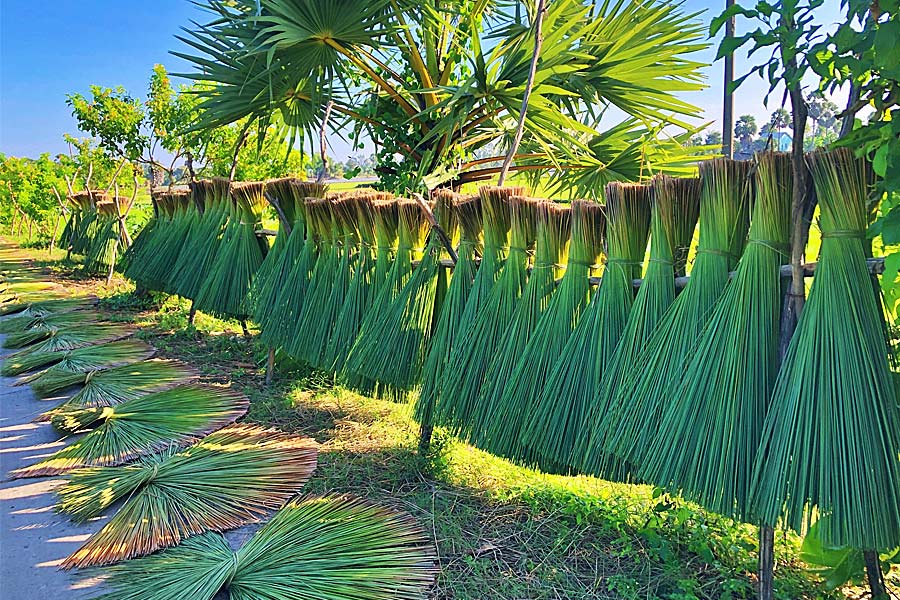
However, according to long-time craftsmen, the trade dates back more than 70 years. Today, the conical hat–making guild consists of over 36 households. Mrs. Diện’s family has followed this craft for three generations. Unlike the Central region, where poetic conical hats are made using buông leaves and silk strings, people in Thới Tân A Hamlet and other southern regions use mật cật leaves and bamboo as the main materials. Mật cật is a plant with wide, fan-shaped leaves similar to palm leaves, commonly found in Tây Ninh, Phú Quốc, and Cà Mau. The plant is short and grows in clusters, with sharp thorns along both sides of the leaf stalk. Each mật cật tree produces only one young leaf, which is selected for hat making. To make a conical hat, artisans need a cone-shaped frame matching the hat’s size, locally known as a “Mô,” which is sold at markets. Before the 1980s, conical hats made from these frames typically had 15 rims. After the 1980s, consumer preferences changed, and people in southern Vietnam began favoring the Huế-style conical hat with 16 rims, also known as the Poetic Conical Hat.
As a result, artisans in Thới Tân A quickly adapted their techniques, adopting Huế-style frames to meet market demand. Materials for making a conical hat include size-10 hand-sewing needles, colored thread, size-04 nylon cord, newspaper for lining, bamboo ribs, and mật cật leaves. Unlike the method used in Tây Ninh—where bamboo ribs are placed on the mold while sewing—artisans in Thới Tân A first fix the rims onto the mold, then arrange the leaves. The next step is rotating the leaves on the mold, a crucial process requiring experience to ensure even and aesthetically pleasing layers: first the inner leaf layer, followed by a layer of newspaper, and finally the outer leaf layer. After shaping the top of the hat, artisans place an outer rim over the mold to hold the leaves firmly in place, making sewing easier. The sewing stage itself is relatively simple compared to other steps, as long as the stitches are even and properly spaced. The final step is securing the rim, an important process in which artisans shave a flat bamboo strip called a “tiến” and attach it to the 16th rim, ensuring the hat is round, sturdy, and durable. Additionally, artisans decorate the inside of the hat’s peak with colored embroidery threads—red, blue, pink—forming star or floral patterns to enhance the product’s beauty.
It is known that the current market price of one kilogram of mật cật leaves ranges from 80,000 to 90,000 VND, enough to make about 20 regular conical hats. Once completed, traders purchase each hat for approximately 15,000 VND. On average, artisans earn a profit of about 8,000 VND per hat. Besides their main daily work, an individual can make an additional two to three hats per day, helping to supplement household income. Products from the Thới Tân A conical hat–making guild are mainly sold at Thới Lai Market and other locations such as Vĩnh Thuận and Vĩnh Tuy markets. Although this craft does not bring wealth to local households, its stable market outlet provides steady income for residents and, notably, attracts visitors from all regions to explore this traditional craft village.
Source: Canthotourist