The highlight of the Tri Tôn pottery village is that they do not use a potter’s wheel or apply any technical means. It is purely done by hand with innate experiential skills.

Visiting Tri Tôn in An Giang Province and seeing with your own eyes the An Thuận pottery village of the Khmer people—locally called sóc Phnom Pi, meaning “hill land”—besides rice farming with centuries-old expertise in this riverine region, the Southern Khmer also have silk weaving in Tịnh Biên, ox-cart making, Thốt Nốt wine production, and many other ancient crafts… but the most unique and traditional is the pottery craft in Tri Tôn.
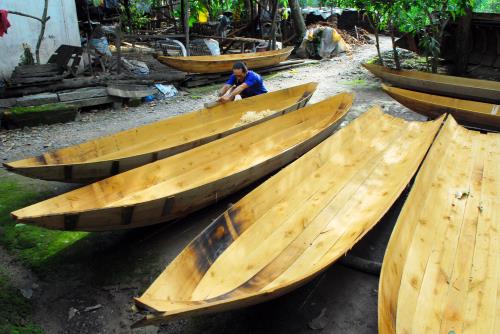
Local history and reports from over a century ago record: During market days, people from various localities would row boats to the Tri Tôn river dock to receive goods. On the docks and boats, carts and porters carried loads down to the riverbank, with pots and pans piled high on large and small boats. It is said that Tri Tôn pottery was not only present in most Mekong Delta provinces but also went up to Tây Ninh and even across to Cambodia, competing strongly with the traditional ceramics famously renowned in the neighboring country. The products were everyday household items such as pots, pans, trã (large basins), cà ràng (a type of stove), and chimneys for Thốt Nốt sugar cooking households. Tri Tôn pottery enjoyed prestige and popularity for many centuries, thanks not only to inherited techniques and attractive shapes but mainly to the quality of the clay and firing method.
The clay for pottery is extracted from the foot of Nam Quy hill, about two kilometers from An Thuận hamlet. This is a fine, smooth, gray clay, and according to long-time artisans, it is the most suitable clay for pottery. Besides the Nam Quy clay, no other place in the region has suitable soil for An Thuận pottery. The clay is brought back, aged for a period, then pounded finely, removing all gravel, stones, and impurities to make it smooth before processing. After thorough sieving, the artisan mixes it with water in a ratio that only years of experience can balance—making the clay pliable but not mushy, cohesive but not dry. It looks simple, but the secret of Tri Tôn pottery likely lies in this simple, experience-based craft technique.
The highlight of the Tri Tôn pottery craft is that they do not use a potter’s wheel or apply any technical means. It is purely done by hand with innate experiential skills. After thoroughly kneading the clay, the artisan walks around the piece to add, build up, smooth, and stroke it. First, they create the basic shape, then adjust and balance the form, and finally smooth the surface. For more intricate items requiring patterns, they use stamping tools with designs created by artisans. In sóc Phnom Pi, almost every household shapes pots, jars, and vats. Children break up the clay, young people knead it finely, and experienced ones shape the items. Most of those shaping pottery in the yards or back gardens are women. This differs from the pottery villages I have seen in the North. They work diligently, patiently, and are particularly quiet. Occasionally, you hear the rhythmic patting sounds as hands slap the sides of vases. Rough, veined fingers deftly stroke and glide around the rims. The water jars and vats take shape without any molds, emerging perfectly symmetrical. Four or five women silently build up the clay, shape the waist, form the mouth, and four or five identical jars appear as if cast from a single mold. When asked about their experience, they just smile: “We don’t know how to explain it.”
After completing the shape, polishing the exterior, and stamping patterns, the unfired pottery is dried thoroughly under the sun for many days before firing. The Khmer do not build kilns. The greenware is stacked layer by layer on the yard or flat ground in the home garden, covered evenly with straw, fired until “ripe,” then cooled in the smothering phase. In industrial processes, each stage is timed and temperature-controlled, but for Tri Tôn people, everything relies on experience. After cooling, the pottery emerges in light red, brown, or deep yellow tones. Finished products don’t need to be transported far for sale. Familiar traders know the way and the owners. They come to each yard and garden, often buying in bulk, transporting to the river dock, and loading onto boats. Heavy boats line up and depart for markets across the six Mekong Delta provinces. Economically today, the Tri Tôn pottery craft does not yield as high an income as some other jobs. Some in the sóc have switched professions, while others continue the ancient craft out of passion and a desire to preserve ancestral traditions. Recently, some foreign cultural and historical experts, mostly Japanese, have visited Tri Tôn to study this long-standing craft village. The Central Ethnology Museum and some local ones have collected and researched the pottery of the Southern Khmer, Cham, and other ethnic groups, viewing it not just as a livelihood but as one of the most distinctive and ancient cultural heritages of the nation.
According to mekongdeltaexplorer