The locksmith profession may seem easy and comfortable, but in reality, it is full of controversies and temptations. Just one moment of misjudgment or being blinded by money, and a locksmith can be exploited by bad actors to assist in wrongdoing. Therefore, besides having a pure heart, a locksmith must also train a sharp eye to distinguish between honest people and criminals.
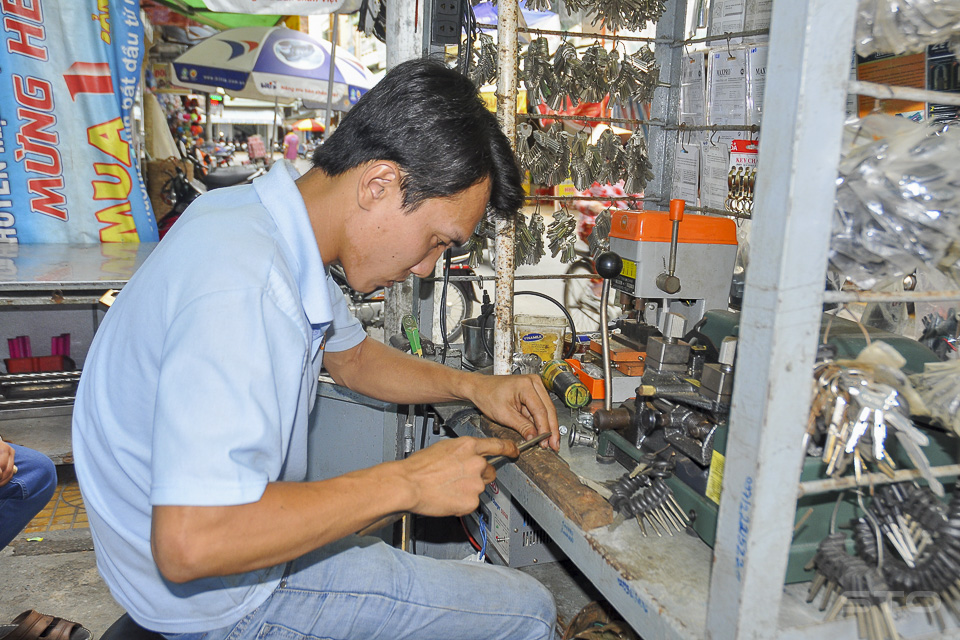
As the first locksmith in Cà Mau and still practicing the trade to this day, Mr. Trần Văn Xê (Ba Xê), 67 years old, declares that he can open any type of lock in the world, including the latest bank safe locks or high-end car locks. However, this profession is often exploited by criminals; just a little carelessness can turn one into an accomplice. That’s why locksmiths are very cautious about passing on their skills—even refusing to teach their own children or grandchildren if they are not upright and mature.
Preserving Professional Ethics Above All
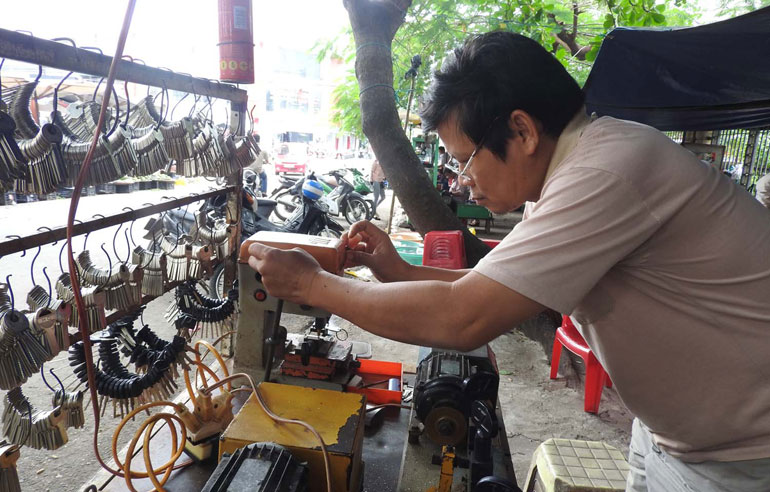
At the foot of Cà Mau Bridge (Ward 2, Cà Mau City), there are nearly a dozen locksmith shops lined up next to each other, yet there is no scene of touting or competing for customers. Whichever shop the customer enters, that shop owner serves them. They even exchange information and help each other open particularly difficult new locks. This is because all the locksmith shop owners here are disciples of the master locksmith Ba Xê.
As the economy develops and wealth becomes more valuable, people’s awareness of protecting their property increases. Seizing this trend, manufacturers continually improve lock durability—replacing ball mechanisms with steel tubes or steel plates; changing keys from flat to round or cruciform; using increasingly robust materials and full-coverage designs that are “saw-resistant and cut-resistant.”
However, according to Mr. Ba Xê, the real challenge of the locksmith profession lies in maintaining professional ethics—never wavering in the face of money and never aiding wrongdoers. No matter how durable a lock is, it is still built on the principle of pin arrangements, steel wafers, and key operation. With enough time and study, a skilled locksmith can still open it. Even long car keys (nearly 10 cm) or electronic door locks—he still has ways to “handle” them.
Rolling up his trouser leg to reveal a prosthetic leg, Mr. Ba Xê explains that this is what drew him into the locksmith trade. He began practicing at age 25, right after a tragic accident that cost him one leg, leaving him at a dead end in life. He learned the basics in Cần Thơ in 3 weeks, then went to Saigon for advanced training at the Hậu Ký lock shop for another 2 months. After that, he returned to Cà Mau with Tâm Râu and Mr. Năm Chìa Khoá—the first three locksmiths in Cà Mau.
Mr. Ba Xê proudly says that his group has upheld professional principles until the other two friends retired, and he himself has never once been tempted by money.
Through this profession, Mr. Ba Xê has supported his wife and children for the past 42 years. His disciples—some illiterate, some disabled, some at the end of their rope in life—number in the dozens. He taught them the trade, and they went on to establish themselves, living comfortably without fear of hunger. “I just recently ‘graduated’ one disciple in Tân Thành, Cà Mau City.
His name is Tèo; he lost one leg in a traffic accident. His fate is exactly like mine. On the third day of Tết, he came to visit me very excitedly, saying he had already opened his own shop,” he boasted.
Almost every locksmith has at least once in their life encountered criminals requesting them to open locks or make keys. Depending on the situation, they refuse—but there is an unwritten rule: all the locksmiths we met refuse to make duplicate keys from impressions on clay, beeswax, or drawings on paper…
Traps Everywhere
Even with great caution and constant admonition to his disciples, recently two of Mr. Ba Xê’s own students could not avoid an occupational mishap. They were repeatedly summoned by the provincial police to reconstruct the scene of a questionable lock-opening case in Ward 4, Cà Mau City.
The incident occurred in June 2013 and caused a great stir about the ethics of teacher and students. Mr. Ba Xê recounted that on that day, he did not man the shop himself but left it to two disciples named Khang and Thái. In the afternoon, someone came and asked them to go open a safe in Ward 4, Cà Mau City.
When they arrived, they saw the safe inside the homeowner’s room, with 5–6 family members present, watching and filming the entire unlocking process—so the two craftsmen had no suspicion at all. After finishing, they were paid 400,000 VND and happily went out drinking together.
More than a month later, the police came to summon both of them for investigation. Only then did the two disciples realize in shock that the safe had been brought over from someone else’s house. They were depressed for months and were scolded by their master for not upholding professional principles. Mr. Ba Xê explained that in such a situation, they should have requested the presence of local authorities as witnesses—to protect both the customer and themselves from future trouble.
“Have you ever been asked by thieves to help open locks?” Without hesitation, Mr. Ba Xê looked straight at us and said: “Of course! They even openly said how much percentage they would give me from the ‘job.’ But I never do anything wrong!”
He recounted that six years ago, four men drove from Kiên Giang province to negotiate with him to open a company safe. They promised to drive him home in a car and give him 100 million VND if successful.
He refused immediately without a second thought, saying even one billion VND wouldn’t make him do it. “Normally, no one pays such a huge amount just to open a legitimate lock. You don’t even need much observation—it’s obviously a shady deal,” Mr. Ba Xê asserted firmly.
Just over two months ago, a plump woman came to his shop and bluntly asked him to help open a safe to steal money from her mother-in-law, promising a big reward. Furious, he trembled with anger and immediately chased her out of his shop.
Mr. Ba Xê said the most regrettable thing in his 42 years as a locksmith was mistakenly accepting one student—the brightest one he ever taught. That was his very first disciple, named Bảo, commonly called Một. Within just a few days of learning, he seemed to master all the master’s secrets.
One fine morning, while teacher and student were having breakfast, the police arrived, handcuffed Một, and took him away. Mr. Ba Xê was stunned to learn that his favorite student was the main culprit in a major theft at the Bảo An Đường herbal medicine shop the previous night. “He opened every door in the pharmacy so his accomplices could loot everything. After treating me to breakfast, he was arrested by the criminal police and sentenced to 7 years in prison. I teach ethics with all my heart—those who follow it prosper; those who betray the profession are finished,” Mr. Ba Xê concluded.
Self-Amputation After Helping the Wrong Person
Mr. Ba Xê and the old masters in Cà Mau’s locksmith trade often remind each other—and their disciples—about the story of Mr. Sáu Khoá in Cần Thơ, who cut off his own finger joint. Before 1975, Mr. Sáu Khoá was a renowned locksmith in the Hậu Giang area. He was asked by a man to open a safe at home and was generously rewarded.
Later, he was sentenced by the court to 6 months of suspended imprisonment for complicity in a husband stealing his wife’s private property. After the verdict, Mr. Sáu Khoá went home and immediately chopped off the joint of his left index finger to remember the lesson for life. He swore that unless both husband and wife were present—or there was a police officer—he would never open an iron safe again.