At its peak, Cà Mau mats were traded far and wide across the country and were even exported to neighboring countries such as Laos and Cambodia. Cà Mau mats were favored by many people thanks to their traditional hand-weaving techniques, which made them durable and beautiful. Today, however, for many reasons, the mat-weaving craft villages of Cà Mau are gradually shrinking.
- A Forgotten Lament
Perhaps among us—the people of the South—there is hardly anyone who does not know the famous song Tình anh bán chiếu by composer Viễn Châu, performed so memorably by the renowned artist Út Trà Ôn. That song helped honor and leave a deep, lasting impression of the mat-weaving craft—Cà Mau mats.
From the moment a Vietnamese person is born, they lie on a small woven mat. Upon reaching adulthood and getting married, they eagerly choose a pair of wedding mats. And when they pass away, their body is shrouded in a new pair of mats. In other words, a mat accompanies a person throughout their entire life—yet how many truly understand the sun, rain, and hardships endured by the diligent mat weavers who create them?
According to veteran artisans, in Cà Mau the mat-weaving craft once flourished strongly in many localities such as Tân Lộc (Thới Bình District) and Tân Duyệt (Đầm Dơi District), but the most famous were the patterned “chiếu lẫy” mats of Tân Thành, Cà Mau City.
Chiếu lẫy are meticulously woven mats featuring various patterns imbued with specific meanings, such as birds, flowers, and foliage. Buyers often ordered them for special occasions—to decorate the bridal bed, or as gifts for friends and relatives. To produce such mats, generations of mat weavers have gone through a process of continuous creativity spanning hundreds of years.
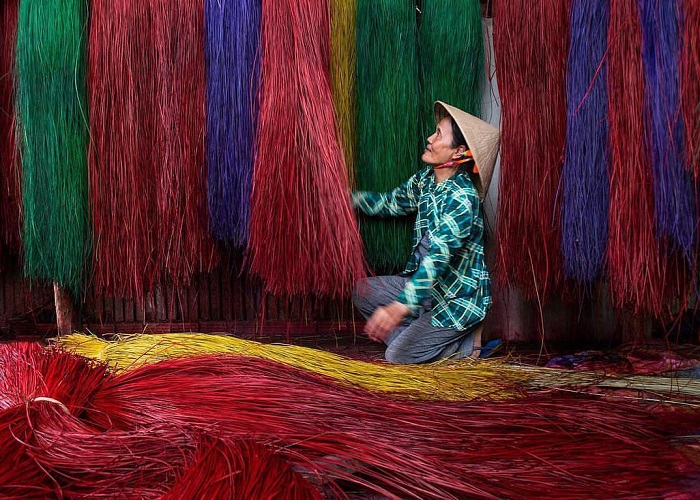
With great skill and creativity, mat weavers interlace sedge strands dyed in different colors to create hundreds of designs: dragon and phoenix motifs for weddings; mats featuring parallel verses wishing good fortune during festivals and Lunar New Year; images of birds, landscapes, rivers, mountains, and waterways. Thanks to this artistry, Cà Mau mats once held a solid position in the market. They traveled far and wide, alongside three-plank boats and cargo boats, reaching consumers both inside and outside the province.
Today, however, for many reasons, the mat-weaving villages of Cà Mau are steadily declining. In Tân Thành Commune—once home to a renowned mat village—very few people remain devoted to the craft. Weavers now produce mats only when there is a prior order, because weaving in advance without buyers would result in heavy losses.
Ms. Trần Như Thảo, Vice Chairwoman of the Women’s Union of Tân Thành Commune, said regretfully: “Nowadays, the main source of income for residents comes from eel and goby farming, so nearly every household has converted land into fish ponds. One fish harvest can earn more than a whole year of mat weaving, so very few people are still passionate about the craft. As a result, the area of sedge cultivation in the commune has visibly declined.”
According to statistics from the commune’s Women’s Union, Tân Thành currently has no more than 60 households still maintaining the mat-weaving craft. They abandon the trade not only because fish and shrimp farming is more profitable, but also due to difficulties in product consumption, initial investment capital, and local labor shortages.
Ms. Phan Mỹ Giới, Head of the Women’s Union Branch of Hamlet 6, Tân Thành Commune, said that the entire hamlet now has only about 14 households weaving mats, most of whom are long-time artisans. Most of these households have little agricultural land or consider mat weaving merely a supplementary occupation to cover the costs of fish farming.
Ms. Phan Thị Út, 41 years old, who had woven mats since childhood but no longer practices the craft, shared: “In the past, I wove more than a hundred pairs of mats a year, each selling for no less than 200,000 VND. Now, with unstable output and my children choosing other professions, there is no one left at home to continue the work, so I had to give it up entirely and switch to fish farming.”
The solid, well-equipped house where Ms. Út now lives was also built thanks to mat weaving. She shared wistfully: “I really want to preserve the craft, but I have no choice. Mat weaving requires a lot of labor—the whole family has to plant sedge, harvest, dry, and dye it. If the children do not follow the trade, what can we do? Hiring workers is very difficult, as most young people nowadays go to industrial zones in other provinces to work as factory laborers.”
- Where Is the Craft Village Heading?
Unlike before, nowadays people who want to weave mats must not only invest labor but also considerable capital. In the past, sedge grew wild and could be harvested freely, but today uncultivated land no longer exists, so sedge must be purchased. Due to scarcity, sedge prices are now much higher than before.
Ms. Cao Thị Hồng from Hamlet 6 said: “A plot of sedge land used to cost only 1–2 million VND a few years ago, but now it costs 4 million VND, and sometimes people do not even want to sell. There is no such thing as buying on credit—you must pay immediately, or they will sell to someone else.”
Because initial capital is required for mat weaving, many households in Tân Thành’s mat village are now facing difficulties. Ms. Trần Như Thảo added that each household needs to invest at least 3 million VND to purchase materials such as sedge, warp threads, and dyes. While villagers do support and help one another, the effectiveness remains limited.
Another reason why mat-weaving machines risk becoming mere antiques is that the quality and designs of machine-woven mats cannot compare with those made by hand. Because consumers do not favor mats that “lack aesthetic appeal,” products made by weaving machines are very difficult to sell.
Traditional hand-weaving still retains its inherent value, and its products continue to have a place in the market—but the craft is gradually fading. Ms. Phan Thị Út said: “Mat prices have not decreased; in fact, they rise every year with market prices. Currently, a pair of patterned mats costs from 250,000 to 300,000 VND or more. Mat weavers can still make a living, as a family can weave over a hundred pairs of mats a year. However, to truly sustain the craft, people need much greater support from authorities through reasonable policies so that they can feel secure in continuing their work.”
It is known that in the past, Tân Thành Commune established a mat-weaving cooperative, but after some time it has nearly ceased operations due to administrative boundary divisions separating Tân Thành Commune and Tân Thành Ward.
In efforts to revive the mat-weaving craft, the Tân Thành mat-weaving cooperative was once provided by the State with a modern weaving machine. Initially, it was used for a short time, but now it sits idle. Ms. Phan Mỹ Giới shared that the machine cost nearly 40 million VND and operated quite well, significantly reducing weaving time. However, due to the lack of market demand and scarce raw materials, it can no longer be put into operation.
The mat-weaving craft in Cà Mau has existed for generations. Reviving traditional craft villages would also create jobs for idle female laborers in rural areas and contribute to household economic development. However, for this craft to grow and become more effective, mat weavers in Cà Mau urgently need support from local authorities and relevant agencies—especially access to preferential loans to expand production.
Source: Saigon Giai Phong Newspaper