Đẩy Côn – Giàn Côn is the tool that people in the low-lying Đồng Tháp Mười region of my homeland use to make a living during the flood season. No one knows exactly when this profession began, only that for the past 20 years, locals have treated đẩy côn as a real, full-fledged occupation.
When the flood arrives, the water turns everything white, bringing fertile silt to enrich the soil and an abundance of fish and shrimp. Setting aside fieldwork, the people of my homeland begin a new season of livelihood: the season of đẩy côn to catch field snakehead fish (cá lóc đồng).
If you ever have the chance to visit the lowlands during the flood season and enjoy the fragrant, sweet grilled field snakehead fish roasted over straw, have you ever wondered what tool the farmers use to catch them?
You’ll find it incredibly fascinating to learn that for more than 20 years, people have been “hunting” snakehead fish across the flooded fields using đẩy côn…
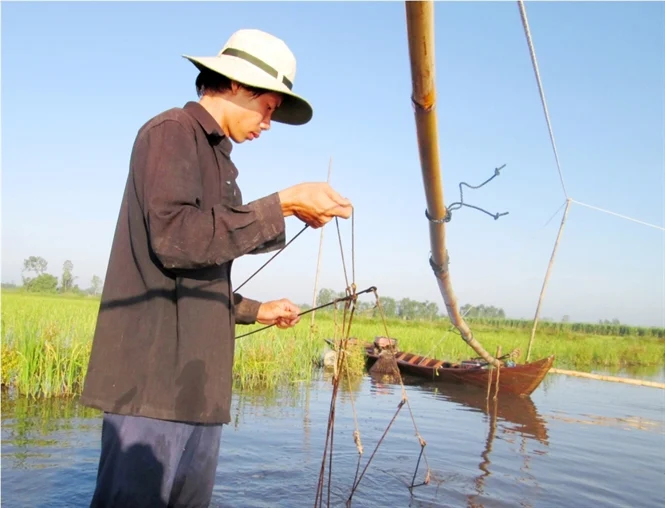
Đẩy côn is not only a tool that brings high income to the people, but it also helps protect the ecosystem—only catching mature fish and leaving the small ones unharmed, unlike other methods.
In simple terms, a giàn côn (côn frame) is a device that stirs the water. When fish bump into the côn, they startle and dive into the mud. The fishermen then watch for the telltale bubbles rising from the water and use a nơm (conical net) to scoop them up.
The côn is made of iron rods about the thickness of a little finger, each 1.5 meters long. One end of each rod is tied to a nylon string, and they are connected into a row like an “iron fence” with 20–30 cm spacing between rods. Two long, straight bamboo poles serve as the frame arms, arranged in a V-shape at the bow of the boat. Each arm is 12–15 meters long. To keep the frame balanced and adjust its height according to water level, vertical poles about 3–4 meters tall are used to support the arms.
To start đẩy côn, the rods are attached to the arms and adjusted to the right height. The fisherman then stands on the boat and uses a long pole to push it forward. As the boat moves, the côn frame is dragged along, startling the fish into diving and creating visible bubbles on the surface. The fisherman simply uses the nơm to catch them.
Đẩy côn usually starts at 6 a.m. and again around 3 p.m., when the temperature is cooler and fish come up into the fields more actively. According to flood-region locals, among all fishing methods, using côn is relatively simple, requires low investment, yet is highly effective, providing a significant income for many Mekong Delta households. However, not everyone can do it—it demands good physical strength to wade through flooded fields all day, enduring sun and rain. Most importantly, it requires sharp observation skills to spot the fish bubbles—a talent only those lifelong farmers steeped in river life and fish behavior truly possess.
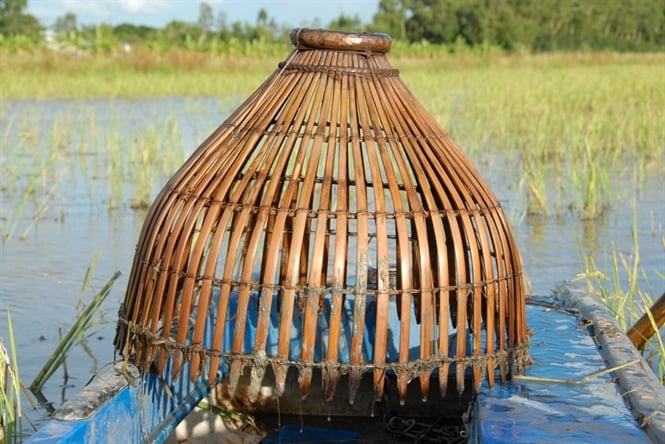
During the flood season, fish arrive in waves. Đẩy côn is a livelihood that helps flood-plain farmers survive. It catches not only snakehead fish but also catfish (cá trê), climbing perch (cá rô đồng), and others. Living in the wild, they may vary in size, but their meat is fragrant, tender, and has that wonderfully lingering natural sweetness—a simple yet profoundly flavorful rural specialty.
Đẩy côn is more than just a tool or a job—it is truly a profession. The practice of “hunting” snakehead fish with đẩy côn has become increasingly common, especially in provinces like An Giang, Đồng Tháp, Hậu Giang, and Vĩnh Long. When the floodwaters arrive and the fields turn into vast white lakes, the đẩy côn profession in the Mekong Delta floodplains comes alive with activity.
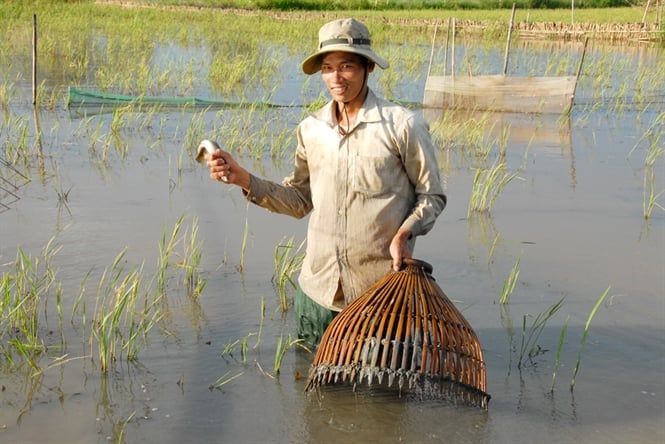
Thank you to the rising waters that bring such generosity to my homeland in the lowlands, bringing a unique cultural identity found only here, and leaving behind an incredibly beautiful memory for those of us who have left home.