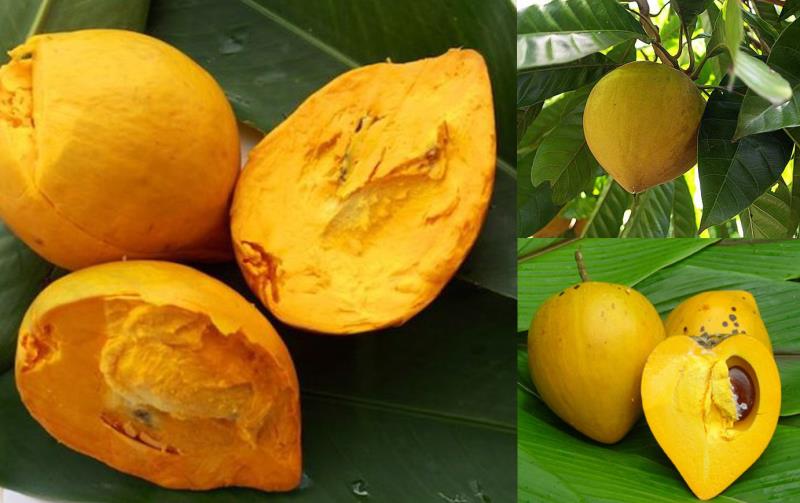
In the past one or two years, the “Dư” fruit (meaning “surplus”) has appeared on the five-fruit trays in Western provinces, symbolizing the hope for a new year with abundant wealth.
The five-fruit tray placed on the ancestral altar during Tet follows five colors representing the wish for “Five Blessings”: wealth, luxury, longevity, health, and peace. It also aligns with the Five Elements theory: Metal (white), Wood (green), Water (black), Fire (red), and Earth (yellow).
In the South specifically, the names of the fruits on the tray are combined to form meaningful phrases praying for prosperity, such as custard apple (mãng cầu), coconut (dừa), papaya (đu đủ), mango (xoài), fig (sung), watermelon (dưa hấu), and pineapple (thơm). When spoken with the local accent, they sound like “Cau vua du xai” (Pray for just enough to spend) or “Cau vua du sung” (Pray for just enough prosperity).
Over the last year or two, the “Dư” fruit (as named by locals) has been added to the five-fruit trays in Western provinces to pray for a surplus of money in the new year. In some Western markets, the “Dư” fruit usually appears from the 25th day of the Lunar December, priced between 10,000 and 20,000 VND. After the 30th day, this fruit is no longer sold.
According to a gardener in Soc Trang, the “Dư” fruit became known about three or four years ago. Initially, people grew it as an ornamental plant because of its beautiful yellow color and long shelf life. Later, traders began visiting gardens to buy them for resale during Tet, which increased the fruit’s value.
Currently, at Tet flower markets, there are also animal-shaped pots decorated with the “Dư” fruit.
The “Dư” fruit’s scientific name is Solanum mammosum L., belonging to the Solanaceae family. It is a small shrub that can grow up to 1.5 meters tall, with many hairs and thorns, and yellow-blue or purple flowers. The plant bears fruit year-round, mainly in autumn and winter.
The fruit is yellow, glossy, 5-8 cm long, wide at the base, and has several protrusions near the stem. According to many, a “Dư” fruit is more valuable when the five “surplus” parts (protrusions) are equal, representing full and well-rounded abundance.
This plant originates from Central America (Virginia) and was imported for ornamental purposes. Today, it is sometimes found growing wild in places like Lam Dong and Dong Thap.
However, the “Dư” fruit is only for display during Tet and is not edible because it contains solanine, making it act as an anesthetic. In Hainan, the entire plant is used to treat scrofula. In Saint-Dominica, an extract is used to treat pain in the cardiac region…
By Bang Tam