Viewed from above, Trà Tim Pagoda and Sóc Trăng Airport appear as if they are located on a giant ship, with the pagoda positioned at the bow (from the direction of Bạc Liêu) and the airport situated at the rear.
Trà Tim Pagoda was established nearly 500 years ago on a high sandy mound. It is located on a spacious campus of 38,631 square meters, featuring hundreds of ancient sao and dầu trees, and surrounded by a fence separating it from the outside.
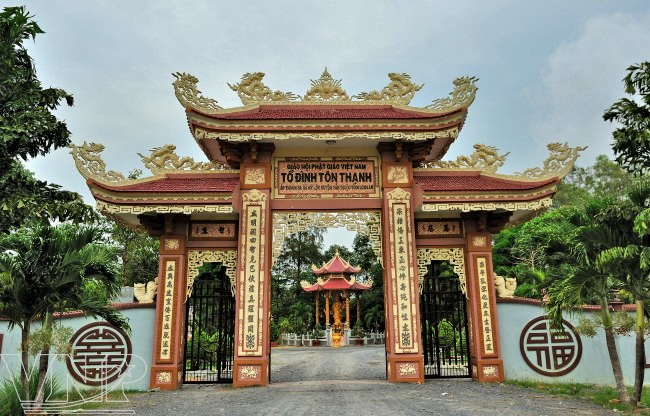
After many renovations, the pagoda has been upgraded to a more spacious and dignified appearance. The main gate faces east and is built of concrete. The gate arch consists of a structure shaped like three towers with embossed decorative patterns. At the base of the gate are statues of two seven-headed dragons on either side, with their bodies extending inward to form railings, above which there are roofs providing shade for visitors to rest.
From the gate, a 4-meter-wide concrete-paved road leads straight into the pagoda, passing through major structures such as the main hall, the assembly hall (sala), the Pali school, the reliquary towers, and the crematorium, all of which strongly reflect the decorative artistic style of Southern Khmer culture. The main hall, where Shakyamuni Buddha is worshipped, is always the most magnificent structure, occupying the central position in the overall layout of the pagoda. The building rises majestically on a platform 2.6 meters higher than the ground, featuring two main doors facing east and two rear doors facing west. The roof of the main hall is about 1.5 meters high and is supported by round concrete columns approximately 6 meters tall. At the top of each column is a statue of a bird-bodied deity with wings in a flying posture, raising both hands to support the roof, giving the structure a light and graceful appearance. These columns are evenly spaced from the inner walls, forming corridors where visitors can stroll around to admire the scenery before entering the sanctuary.
Not only a place of worship, Trà Tim Pagoda has long served as a base for revolutionary forces during attacks on Sóc Trăng Airport (1963, 1973). Notably, during the General Offensive and Uprising of the 1968 Tết Mậu Thân, this site was a gathering point for our troops advancing into Sóc Trăng town, inflicting heavy losses on the enemy. The monks and Buddhists of the pagoda repeatedly organized protests against forced conscription campaigns and rose up against the intention of the puppet army and administration to relocate the pagoda in order to turn it into an airfield, which would have been used to expand their foothold for suppressing the resistance movement of our army and people.
Today, in the process of building and developing the homeland, the pagoda organizes many ethnic language classes for children living nearby, encourages local residents to follow the principle of “a good life and beautiful faith,” and contributes efforts to building infrastructure, promoting a civilized lifestyle, and fostering cultural families. The pagoda has been recognized as a civilized place of worship and listed as a provincial-level scenic and cultural heritage site. Every year, during festivals such as Chôl Chnăm Thmây, Đôlta, and other celebrations, in addition to Khmer locals, the pagoda attracts numerous visitors from all over who come to worship the Buddha, visit the pagoda grounds, and enjoy cultural and artistic activities rich in ethnic identity.
Source: soctrang.gov.vn