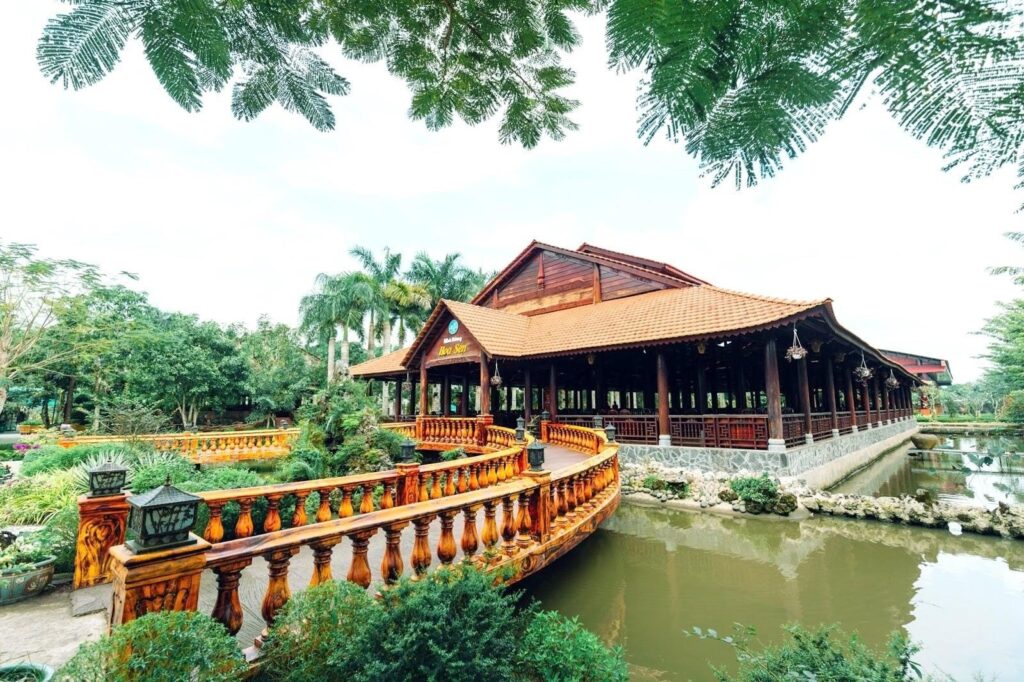
When visiting Cần Đước, do not forget to stop by an ancient architectural and sculptural masterpiece in Long Hựu Đông Commune that local people commonly call the House of One Hundred Columns.
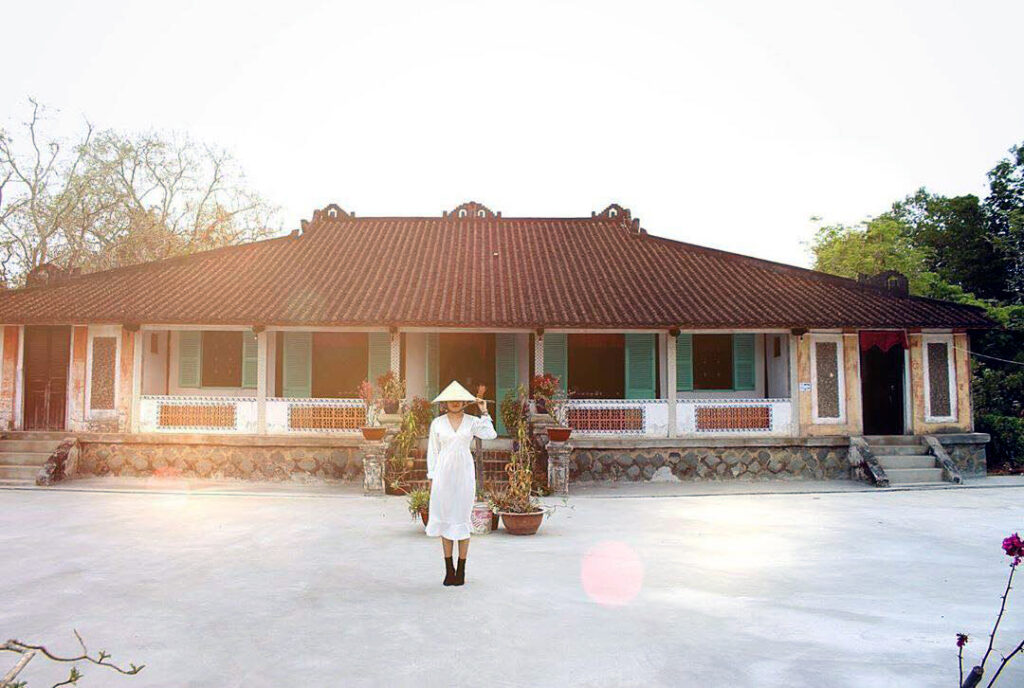
The third-generation owner, Mr. Trần Văn Ngộ, recounts that this house was built by his grandfather, Mr. Trần Văn Hoa—who was then the Hương Sư (village scholar) of Long Hựu Village, Lộc Thành Hạ Canton, Chợ Lớn Province—between 1898 and 1903. Fifteen artisans from the imperial capital of Huế were invited to construct the house, spending two years laying the foundation and three years carving and decorating the interior ornaments.
With a floor area of 882 m2, the House of One Hundred Columns is situated within a spacious garden of 4,044 m2, facing northwest. The entire house is made of precious woods (rosewood, red ironwood, mật wood), with a yin–yang tiled roof. The foundation is built of stone blocks rising 0.9 meters above the ground, and the floor is paved with hexagonal terracotta tiles. In its ground plan, the house follows the shape of the Chinese character “quốc” (國), consisting of three main bays and two side wings. Strictly speaking, the house actually has up to 160 columns rather than just one hundred; “One Hundred Columns” is merely a symbolic name.
The house consists of two main sections: the front section serves as the ancestral worship and guest reception area, while the rear section is used for living and daily activities. The granary at the very back was dismantled in 1952 and now only its foundation remains. The main structural system of the House of One Hundred Columns follows the xuyên trính style (also known as đâm trính or rường house), with an eight-pillar framework oriented along the west–east and front–rear axes. Structural components such as beams and crossbeams are finely molded and curved in the traditional Central Vietnamese rường style. The junction between the main beams and crossbeams that support the ridge beam is stylized in the shape of a “mortar and pestle,” symbolizing the harmony of yin and yang (hence also called the mortar-and-pestle house style). This traditional structure offers many advantages due to its remarkable sturdiness. The wide, open central space—without middle columns—is especially suitable for ancestral worship.
Notably, the interior decoration of the House of One Hundred Columns reveals the exceptionally high level of sculptural art achieved by artisans of the past, evident in composition, subject matter, and technical execution. The entire system of trusses and beams is elaborately carved in high relief and openwork with themes such as “clouds transforming into dragons” and the “four seasons” in the distinctive Huế-style “foliage-vine transformation,” rendered with remarkable sharpness. The ancestral worship and guest reception halls embody the highest aesthetic values of the structure, where generations of artisans left their mark in every carving. These include a rich and diverse array of classical motifs such as the “four sacred animals,” the “four seasons,” and the “eight fruits,” along with symbols of Prosperity–Longevity–Happiness, Western motifs like roses and squirrels with grapes, and Southern Vietnamese elements such as custard apples, calabash trees, starfruit, and mangosteen. All are meticulously crafted on decorative panels, lattice frames, partitions, ventilated walls, altars, ceremonial chairs, round tables, and long tables using sophisticated techniques such as openwork carving, high relief, deep carving, and relief-on-openwork—demonstrating extraordinary mastery and artistry.
A distinctive feature of the woodcarving style here lies in the combination of skillful, meticulous realism—often constrained by feudal conventions—with a more liberal and stylized approach, characterized by a large number of “foliage-vine transformation” patterns. This blend adds richness, vitality, and emotional appeal for viewers. The guest reception hall of the House of One Hundred Columns is further adorned with horizontal lacquered boards and parallel sentences, gilded and inlaid with mother-of-pearl, expressing ideals of a tranquil life, admiration for natural beauty, prayers for blessings, and wishes for longevity. All elements are harmoniously composed and treated within the architectural space, exuding both the solemnity of an ancestral house and the splendor of a traditional sculptural architectural masterpiece.
According to researchers, the House of One Hundred Columns represents a Nguyễn Dynasty architectural style, bearing a strong Huế influence overall. However, as it was commissioned by a private owner in the Southern region during the French colonial period, it also incorporates many unique variations in decorative themes, creating richness and diversity. It stands as a vivid testament to the cultural and historical landscape of Southern Vietnam in the late 19th and early 20th centuries. In recognition of these values, in 1997 the House of One Hundred Columns was officially designated a National Historical and Cultural Relic by the Ministry of Culture and Information.
Source: longangov