Some people have attributed inaccurate and historically unfounded claims to National Hero Nguyễn Trung Trực. Over many years, his descendants have repeatedly demanded that the historical truth be restored, yet the relevant authorities have still failed to re-examine the matter.
Puzzling Royal Decrees
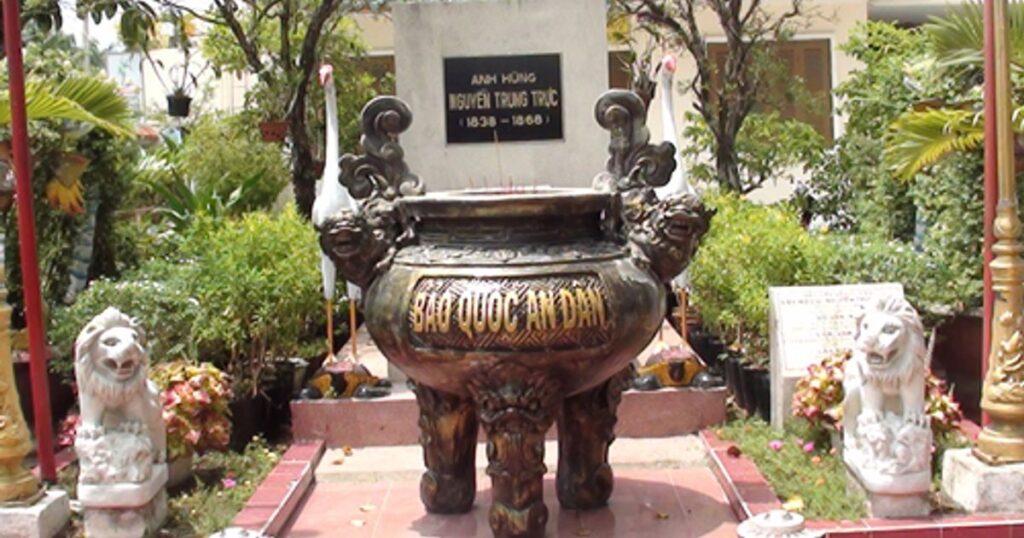
In a petition sent to press agencies, Mr. Nguyễn Khương Ninh (born in 1949, a fifth-generation descendant of National Hero Nguyễn Trung Trực, currently residing in Zone 2, Cái Bè Town, Tiền Giang Province) pointed out several inaccuracies by authorities in Kiên Giang Province. During the annual memorial festival commemorating the hero’s death, there is an extremely important ritual that attracts thousands of participants—the ceremonial procession of royal decrees, which stretches for several kilometers and ends at the Nguyễn Trung Trực Temple. Through his inquiries, Mr. Ninh was informed by the Temple Relic Protection Board (in Rạch Giá City, Kiên Giang) that the temple currently preserves two royal decrees: one conferring the title “Great General of the Southern Sea of the Đại Càn National Realm,” bestowed by Emperor Tự Đức in 1852; and another conferring the title “Guardian Deity of the Locality” (believed to have been bestowed upon National Hero Nguyễn Trung Trực), also issued by Emperor Tự Đức in the same year.
According to the Vietnamese dictionary, a royal decree (sắc thần) is an imperial document used to confer divine titles and ranks upon deities worshipped in village communal houses. These deities could be historical figures who rendered meritorious service to the country or contributed to land reclamation and village establishment. The claim that Emperor Tự Đức conferred such a title upon Nguyễn Trung Trực in 1852 is entirely unreasonable, as he was born in 1838. At that time, he was only 14 years old, had not yet participated in resistance against the French, and had not sacrificed his life—thus could not have been deified. There are also official documents from the Huế royal court indicating that Emperor Tự Đức had no knowledge of Nguyễn Trung Trực. Author Nguyễn Nghị, citing the “Extracts from the Privy Council Records” dated February 6 of Tự Đức’s 24th year (1872), noted: “Only four years after Nguyễn Trung Trực’s death did the Huế court issue documents requesting a thorough investigation into the origins and deeds of these two individuals (Nguyễn Trung Trực and Hồ Huân Nghiệp)—who they were, whether they had served as officials, whom they followed, what roles they played, and on what date they died—in order to determine whether they should be posthumously rewarded…”. Clearly, neither of the two royal decrees is related to Nguyễn Trung Trực, yet they are solemnly displayed in the temple and paraded in grand ceremonies.
A provincial official in Kiên Giang stated that Nguyễn Trung Trực represents a beautiful chapter in the history and cultural tradition of Southern Vietnam and should be clarified and honored in a scientific manner, rather than ambiguously distorted. The temple in question was originally a shrine dedicated to the Whale Deity (Nam Hải). According to folk tradition, wherever a whale stranded and died, local fishermen would establish a shrine to worship it. In 1852, Emperor Tự Đức conferred the title “Great General of the Southern Sea of the Đại Càn National Realm” precisely upon this shrine.
In 1868, after Nguyễn Trung Trực was executed, the people, out of reverence and gratitude, renovated the shrine and discreetly placed a memorial tablet engraved with his name in classical Chinese inside the temple of the Southern Sea Deity. To deceive the enemy, the anniversary of Nguyễn Trung Trực’s death was outwardly observed as a ritual for the Southern Sea Deity. To further avoid political persecution by the colonial authorities, the people also worshipped the memorial tablet of Deputy Commander Nguyễn Hiền Điều, a court general who had sacrificed his life while suppressing banditry decades before the French conquest of Southern Vietnam. For many years, Mr. Ninh has proposed to the authorities that if the procession of royal decrees is to be held, it must be clearly identified as the procession of the decree conferring the title “Great General of the Southern Sea of the Đại Càn National Realm,” as a remembrance of the temple’s cultural tradition—rather than being misrepresented as a royal decree bestowed upon Nguyễn Trung Trực.
Descendants Supposedly Living… in Cà Mau
For a long time, some authorities accepted a highly implausible hypothesis that Nguyễn Trung Trực’s descendants lived as far away as Cà Mau. In October 1988, Kiên Giang Province organized a scientific conference on the life and career of National Hero Nguyễn Trung Trực. Ms. Nguyễn Thị Mỹ Thu (Director of the Kiên Giang Provincial Museum) and Mr. Dương Văn Cầu (a provincial history official) presented a paper titled “Another Discovery Regarding the Lineage of the National Hero Nguyễn,” introducing an alleged descendant branch in Tân Thuận Commune, Đầm Dơi District, Cà Mau. According to the Tân Thuận clan genealogy (Minh Hải), Nguyễn Trung Trực was the eldest of eight siblings, followed by two sisters; the fourth was Nguyễn Công Khanh, the fifth Nguyễn Thành Luông, the sixth (unnamed), the seventh a sister, and Nguyễn Văn Thơ. Currently, there are six graves in Cà Mau, missing only the graves of Nguyễn Trung Trực and the sixth sibling. This clan claimed that the sixth sibling was Nguyễn Thị Đạt, who was supposedly lost in Long An. They also stated that Nguyễn Trung Trực’s father was Nguyễn Văn Phụng, also known as Nguyễn Cao Thăng, and his mother was Lê Kim Hồng. Notably, their genealogy did not include anyone named Nguyễn Trung Trụ among the siblings.
In 2000, Ms. Nguyễn Thị Mỹ Thu instructed Ms. Nguyễn Thị Mai Lan to travel to Cà Mau to verify and construct what was believed to be the tomb of Nguyễn Trung Trực’s parents. Ms. Thu also proposed that the Nguyễn Trung Trực Temple Relic Protection Board in Kiên Giang allocate VND 20 million to support the construction of a mausoleum for this family line in Cà Mau. On April 23, 2001, the People’s Committee of Cà Mau Province issued Decision No. 406 approving the construction plan for the mausoleum of Nguyễn Cao Thăng, alleged father of Nguyễn Trung Trực. On January 3, 2002, the mausoleum was inaugurated, with coverage by the press.
Mr. Nguyễn Khương Ninh filed complaints challenging this unrealistic hypothesis. As early as 1990, he submitted petitions to local authorities and the Kiên Giang Department of Culture and Information (now the Department of Culture, Sports and Tourism) requesting verification. In 1991, Mr. Mạc Liêm, Deputy Director of the department, instructed officials to conduct an investigation together with Mr. Ninh. The investigative team concluded that the Bến Lức–Long An lineage and the Cái Bè–Tiền Giang lineage could be one and the same, and that Nguyễn Trung Trực belonged to these two branches. Meanwhile, the Tân Thuận–Minh Hải (Cà Mau) lineage lacked sufficient scientific evidence to prove any connection to him. To protect historical accuracy, the team recommended that the Kiên Giang Department of Culture and the provincial museum review and correct these errors. One of the clearest inconsistencies was that the age of Ms. Đạt in the Cà Mau lineage was the same as that of Ms. Đạt’s daughter in Long An.
In an earnest open letter sent to authorities, Mr. Ninh implored that all issues related to Nguyễn Trung Trực be returned to historical truth and factual accuracy. Most recently, on September 9, 2014, the Department of Cultural Heritage under the Ministry of Culture, Sports and Tourism issued a notice confirming receipt of Mr. Nguyễn Khương Ninh’s complaint regarding issues related to the historical figure Nguyễn Trung Trực. The Department forwarded a copy of the petition to the Kiên Giang Department of Culture, Sports and Tourism for consideration and resolution. Unfortunately, to date, no response has been given, and the 146th anniversary of Nguyễn Trung Trực’s death continues to be commemorated on the wrong date, with the procession of royal decrees still being carried out.
Source: Ho Chi Minh City Police Newspaper


 Open flight routes from Phu Quoc to Singapore and Siem Reap.On September 24, in Ho Chi Minh City, the People’s Committee of Kiên Giang Province, Vietnam Airlines, and Vinpearl Joint Stock Company jointly held a ceremony to announce the comprehensive trade promotion cooperation program titled “Phu Quoc Destination,” while simultaneously launching two new international air routes departing from Phu Quoc (Kiên Giang Province): Phu Quoc...
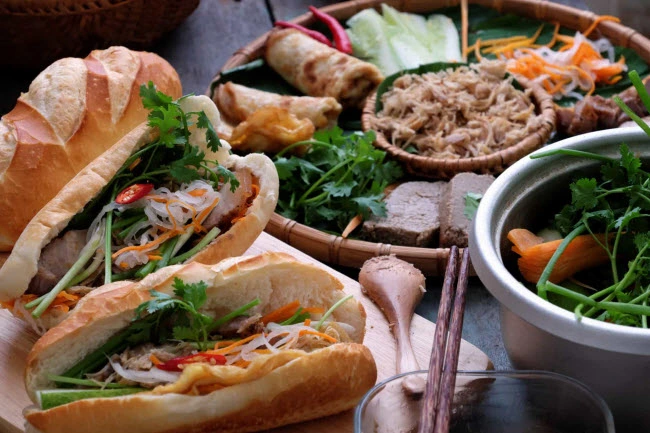
 Banh mi – a Vietnamese street food enjoyed worldwide.Bánh mì – the street food bread of Vietnam, has been praised by foreigners in recent times, and it seems that bánh mì has truly “taken the throne” from phở to become the most beloved Vietnamese dish among international fans. There’s one thing that has always bothered me whenever I think about Vietnamese cuisine on...
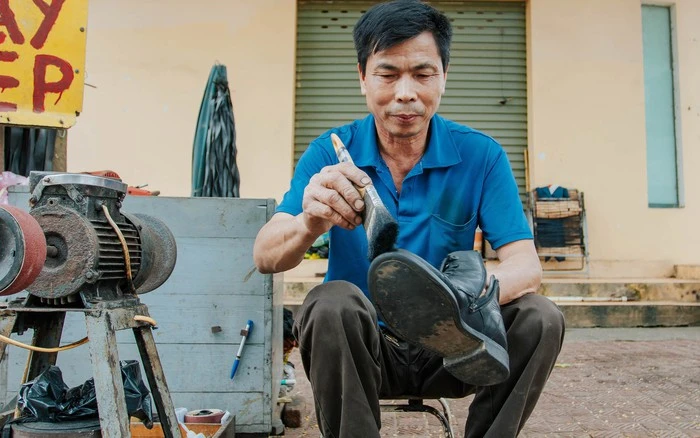
 The joys and sorrows of repairing old shoes and sandals.With just a few awls and a pair of scissors, these craftsmen can “patch up a life” for old shoes and sandals—and sometimes, patch up their own lives as well. This humble shoe-repair trade has seen artisans remain devoted to it for nearly 30 years. A Family’s Traditional Trade At an intersection in Mỹ Tho...
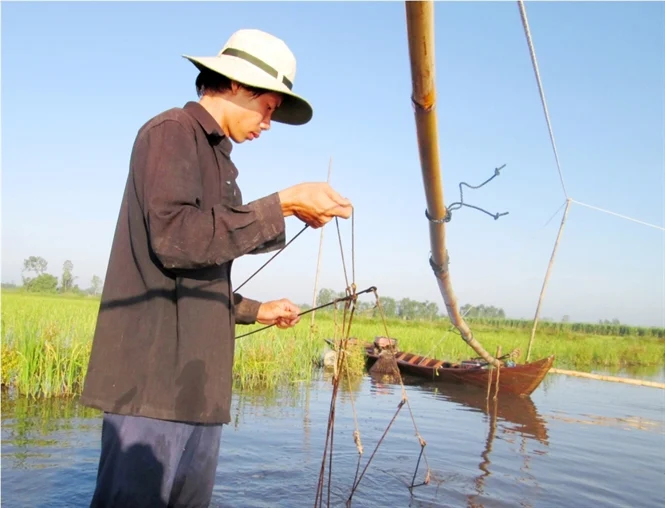
 Pushing the boat during the flood season in the rice fields.Đẩy Côn – Giàn Côn is the tool that people in the low-lying Đồng Tháp Mười region of my homeland use to make a living during the flood season. No one knows exactly when this profession began, only that for the past 20 years, locals have treated đẩy côn as a real, full-fledged occupation. When...
 Can Tho ranks among the cities with the most beautiful canals in the world.Mysteriousworld has just published its list of the cities with the most beautiful canals in the world, praising Can Tho for its lovely canals, floating markets and bustling river trade.
 F Band used the Piêu scarf as a loinclothThe fact that F Band used the Piêu scarf as a loincloth during the X–Factor semi-final night on October 12 was considered improper by cultural researchers, while the Thai ethnic community spoke out, saying they deserve an apology. The X–Factor – Vietnam’s Hidden Factor semi-final night on October 12 was a stage for timeless love...
 A unique horse-drawn carriage set worth 3 billion VND in the Western region of Vietnam.Crafted from 2.2-ton nặng gõ bông lau wood, with a width of 2.15m and length of 4m, this unique ván ngựa set in An Giang has been offered more than 3 billion VND. The owner of this one-of-a-kind 3-billion-VND ván ngựa set is Mr. Nguyễn Thanh Hải, from Mỹ Phó Hamlet, Mỹ Đức Commune, Châu...
 The Locksmith Profession – Upholding the Code of EthicsThe locksmith profession may seem easy and comfortable, but in reality, it is full of controversies and temptations. Just one moment of misjudgment or being blinded by money, and a locksmith can be exploited by bad actors to assist in wrongdoing. Therefore, besides having a pure heart, a locksmith must also train a sharp eye...
 Whose remains lie buried in the tomb of Hero Nguyen Trung Truc?Despite the opposition from descendants of national hero Nguyen Trung Truc and retired officials, for nearly 30 years, Kien Giang province has maintained that the remains in the tomb are indeed those of Lord Nguyen. The Mysterious Search for Lord Nguyen’s Remains On October 27, 1868 (the 12th day of the 9th lunar month), Lord...
 Swarms of snakes, teeming with crabs, and countless rats… at the markets of the Mekong Delta.During the flood season, in the Mekong Delta, special markets appear selling wild-caught delicacies thanks to the rising water, such as eels, snakes, turtles, field rats, snails, crabs… When the flood recedes, these markets gradually become quiet, and people call them “Mekong Delta seasonal markets.” Snakes are sold in many places throughout the Mekong Delta,...
 Famous types of fish sauce in VietnamVietnam is not only famous for its abundance of fish species, but its various types of fermented fish paste also contribute to the distinctive flavor of our cuisine. Each region has its own type of fermented fish paste, such as shrimp paste, fish paste, crab paste, and prawn paste, etc. Remember to try them as you travel through these regions!