Despite the opposition from descendants of national hero Nguyen Trung Truc and retired officials, for nearly 30 years, Kien Giang province has maintained that the remains in the tomb are indeed those of Lord Nguyen.
The Mysterious Search for Lord Nguyen’s Remains
On October 27, 1868 (the 12th day of the 9th lunar month), Lord Nguyen was captured by the French and beheaded at the Rach Gia market. Regarding his body, many believed the French displayed his head in the middle of the market to intimidate the public, but it was stolen by someone during the night. To date, no documents have confirmed where Lord Nguyen’s body was buried. According to one hypothesis, his body was buried in a secluded, secret location for fear that people would exhume his remains to use as a symbol to continue the uprising against the French. Some suggest the French buried his remains within the Administrator’s Palace (Dinh Tham Bien), secured with stakes and chains. Others believe he was buried on the grounds of the provincial governor’s palace, where a tomb surrounded by iron chains existed at that time. However, some identify this as the grave of a French naval lieutenant, where the surrounding chains were merely decorative and included an iron anchor.
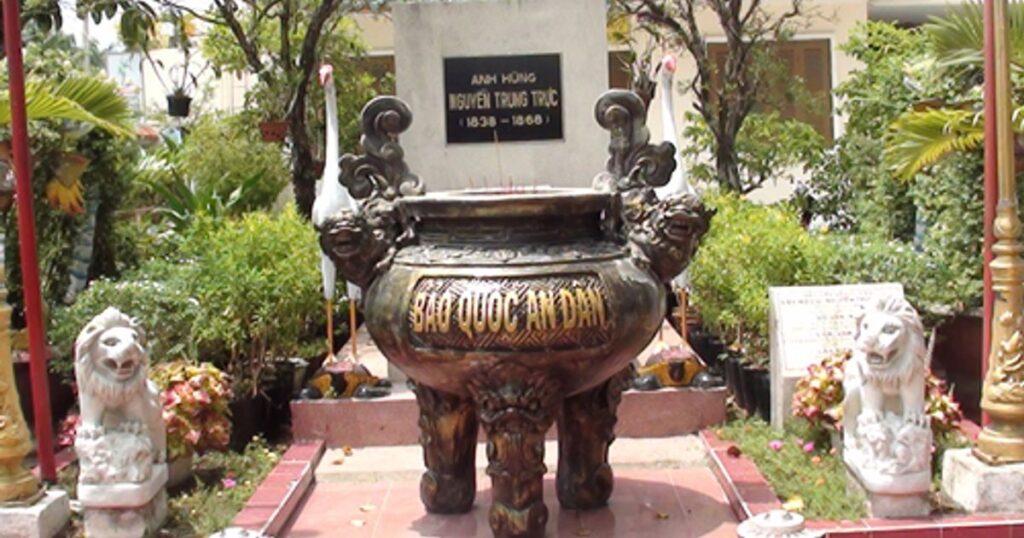
Around 1970-1971, Nguyen Van Tai, the provincial governor of Kien Giang under the Saigon puppet government, commissioned a bronze statue of Lord Nguyen to be placed in front of the Rach Gia Market Hall. He once offered a reward of 1 million VND and a trip to Singapore to anyone who could find Lord Nguyen’s remains for burial, but there were no results. After many searches, in 1986, following the guidance of writer Son Nam, the Kien Giang Department of Culture excavated a tomb believed to be Lord Nguyen’s within the old governor’s palace grounds and moved the skeletal remains to Lord Nguyen’s temple in Rach Gia town. Since then, during festivals and death anniversaries, thousands of people have come to worship and show their gratitude to National Hero Nguyen Trung Truc.
Beheaded, But Neck Vertebrae Intact
In April 1986, guided by writer Son Nam, the Kien Giang Museum organized an excavation of a tomb beneath a banyan tree at the Kien Giang Provincial People’s Committee headquarters, believed to be the burial site of Lord Nguyen. The Kien Giang Museum invited Mr. Le Trung Kha, an archaeological expert in zoology and anthropology from Ho Chi Minh City, to participate in identifying the remains. The main content of the museum’s excavation report recorded Mr. Le Trung Kha’s observations (though it lacked his signature and misspelled his last name as Nguyen Trung Kha): “Vietnamese ethnicity, male. Height approximately 1.60m, age about 50 years, buried for over 100 years. The 7 neck vertebrae and jawbone are intact. This person chewed betel and appeared poor as the grave was made of earth, with a coffin of common wood and no funerary offerings.” It is quite shocking: National Hero Nguyen Trung Truc was beheaded by the French when he was only 30 years old, yet the neck vertebrae and jawbone remain intact (?!).
At that time, Mr. Nguyen Khuong Ninh, a fifth-generation descendant of Lord Nguyen, along with several veteran and current officials in Kien Giang, argued that these were not his remains. One of those who strongly reacted against the hasty identification was Mr. Nguyen Tan Thanh (former Chairman of the Kien Giang Provincial People’s Committee, now deceased) and his son Nguyen Tien Dung (then an officer of the Provincial Police). After April 30, 1975, Mr. Thanh was allocated a house within the former French administrator’s compound, and the excavated tomb was right next to his house. He sent a document to the provincial leaders, not only as a local leader but with the sentiments of an admirer of Lord Nguyen. In the document, Mr. Thanh wrote: “Upon re-examining the grave next to my house, I object because before the excavation, I saw it was a coffin made of high-quality wood, with the head, body, and limbs intact, buried properly. When asking local elders, they said it was the grave of a henchman who served the French, and when he died, they had a policy to bury him properly.”
Mr. Ninh went to great lengths to track down documents and discovered two identification reports that were very sketchy and filled with inconsistencies. The first report recorded Mr. Le Trung Kha’s content as stating the age of the excavated bones was 50. However, in the second report, the age was corrected to 40. The corrected report was a carbon copy of the original. According to Mr. Nguyen Khuong Ninh, he went to Ho Chi Minh City to meet Mr. Le Trung Kha. Mr. Kha confirmed that the two reports by the Kien Giang Museum did not accurately reflect his findings. Mr. Kha had personally written two identification reports—one he kept and one he gave to Mr. Duong Van Truyen (then Director of the Kien Giang Museum).
Mr. Kha identified the findings as: “The 7 neck vertebrae and jawbone are intact, proving the deceased was not beheaded; many teeth were worn down with lime deposits, proving the deceased was elderly and chewed betel.” Mr. Kha confirmed that these remains were not those of Lord Nguyen Trung Truc. His original identification report was archived in Ho Chi Minh City.
In addition to Mr. Thanh and Mr. Ninh, who vehemently opposed identifying someone else’s remains as Lord Nguyen’s, prominent figures like Professor Dr. Tran Cuu Kien also voiced their concerns. The objective reality of the remains is clear evidence: they do not match the life of Lord Nguyen, who was beheaded at age 30, while the remains were of a 50-year-old with an intact neck. Furthermore, the tomb was made of stone with Chinese character carvings. Would the French have respected Lord Nguyen enough to build a stone tomb with an epitaph right inside the governor’s palace? The Governor of Cochinchina himself rejected Huynh Cong Tan’s request for clemency for Lord Nguyen because “this man killed too many French soldiers and officers.”
The French chief of Kien Giang, Arnoux (some records say Reneoul), who could read Chinese characters, once left a local festival in anger after seeing Lord Nguyen’s tablet being worshipped, making the local officials tremble with fear. Furthermore, the remains of a National Hero were confirmed with vague, unscientific reports. Regrettably, Kien Giang province has still not addressed the public concerns—is this worthy of the sacrifice of our ancestors?
According to HCMC Police Newspaper