The Ok Om Bok Festival, or traditional ghe ngo boat racing of the Khmer people, is one of the major festivals with profound humanitarian significance. It reflects the strong community bonds of the Southern Khmer people and the spirit of unity and loyalty among the three brotherly ethnic groups—Kinh, Khmer, and Hoa—in the Mekong Delta region.
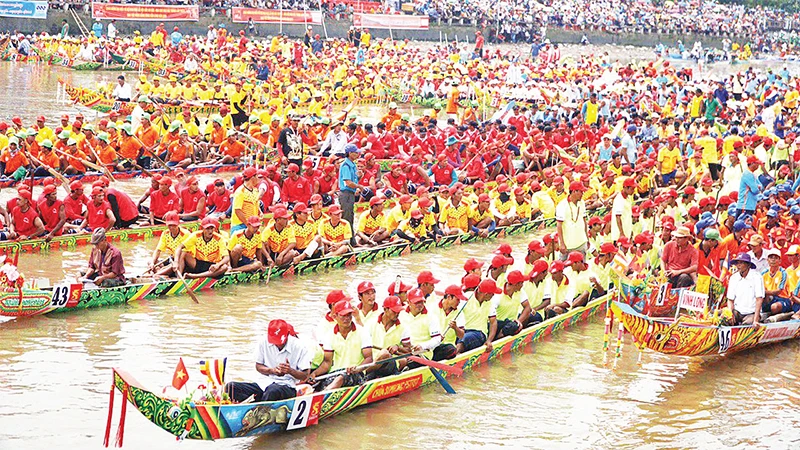
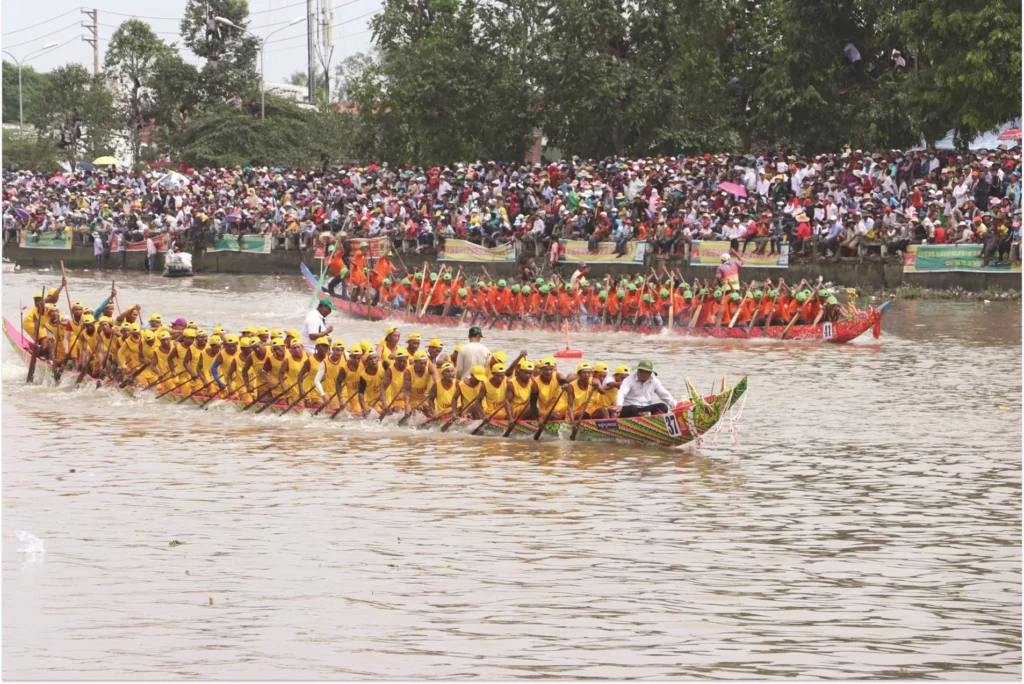
During the Ok Om Bok Festival, there are many rituals: the moon worship ceremony, the water lantern release, the sky lantern release… and the most vibrant is the ghe ngo boat racing competition. In 2013, the ghe ngo boat racing was elevated to the **Festival of Ghe Ngo Boat Racing**, gaining regional and national scale.
The ghe ngo boat carries many unique cultural meanings and values specific to the Khmer people.
The ghe ngo is not the product of any individual or group. Each ghe ngo boat is created and competed by a pagoda, representing one or more Khmer phum sóc (villages/hamlets). Therefore, the victory or defeat of the ghe ngo boats essentially represents the victory or defeat between pagodas, and between the Khmer phum sóc communities.
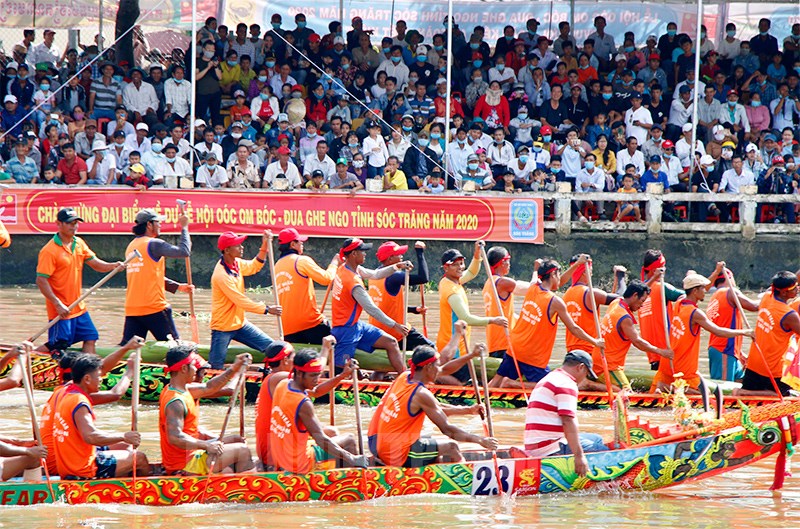
The success or failure of a ghe ngo in the race is also a matter of pride and reputation for the pagoda and the local community participating. Therefore, to achieve success, the Southern Khmer people apply many methods and techniques in crafting the ghe ngo as well as in the competition itself. Spiritual factors are also one of the key elements contributing to the boat’s success.
Originally, the ghe ngo was a dugout canoe hollowed from a single tree trunk, but nowadays, finding such large, long trees is very difficult, so the Khmer people use assembled wooden planks instead.
The ghe ngo is shaped somewhat like a long snake, ranging from 25 to 30 meters in length. At its widest point in the middle, it measures about 1.1 meters. The bow is curved upward like a snake’s head. The stern (rear) is also curved upward but slightly higher than the bow. People install 24 to 27 crossbeams along the boat for two rowers each. Each boat must accommodate 40 to 60 rowers and commanders—for example, the ghe ngo of Bốn Mặt Pagoda (Sóc Trăng) has 53 people, and Ông Mek Pagoda (Trà Vinh) has 57.
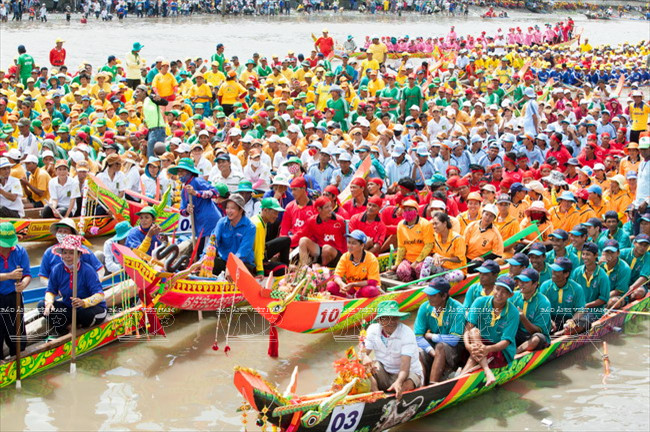
No matter how many rowers a boat has, there are always three key controllers: one at the bow who specializes in spiritual guidance for the racing boat, organizes the launching ceremony, directs the entire boat, and controls the rowing technique; one in the middle and one at the stern who blow whistles to urge and adjust the rowers’ technique.
Each boat has its own unique symbol—this serves as an identifier and also represents the boat’s power. It is usually chosen based on the traditional beliefs of each pagoda, such as powerful or fast animals…
For example, the symbol of Bốn Mặt Pagoda (Sóc Trăng) is a bird, Champa Pagoda (Sóc Trăng) chooses a tiger, Ông Mek Pagoda (Trà Vinh) chooses a cá nược (mythical fish)… The Khmer believe that during the race, the ghe ngo will move with the speed and strength of the chosen symbolic animal. The sides, bow, and stern of the boat are decorated with patterns and colors matching the symbol to enhance its power. If the symbol is the Naga serpent god, the motifs along the hull evoke the image of a serpent, so when the boat glides through the water, viewers feel as if they are watching a divine Naga serpent undulating on the waves.
To create the power for fast movement during the race, the Khmer people attach one or two long poles tightly in the middle of the boat. The Khmer call this the “cần câu” pole, or in some places “cây kềm”. This pole acts as a lever to propel the boat forward swiftly. It is made of high-quality, very hard wood, usually sao wood with a diameter of about 0.2 meters.
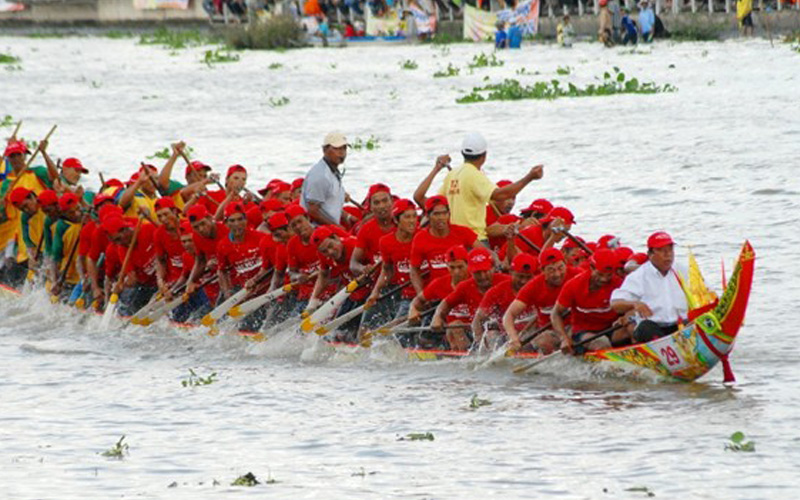
The bow of each boat is painted with two prominent eyes, so the boat can “see” the way and avoid dangers. This belief is similar to the long-standing Southern Vietnamese custom of painting eyes on boats.
The ghe ngo is used only for racing; every activity related to the boat requires a ceremonial prayer, such as the boat-building inauguration ceremony, the boat completion ceremony, and the boat “dressing” ceremony.
Together with the ngũ âm (five-tone) orchestra, the ghe ngo has become two unique and precious cultural assets in the community and religious life of the Southern Khmer people.