In Hoi An commune, Cho Moi district (An Giang), local people still diligently sew each conical leaf hat under simple roofs beside bamboo groves and canals. Neither noisy nor ostentatious, An Giang’s craft villages persist through the endurance of hands and memories. Each hat is the result of many stages and many households, crafted with patience and a quiet faith in an ancient trade. From those simple white hats, we see an entire countryside silently preserving a beauty that is deeply rooted in the life and soul of the people here.
A Century-Old Craft Village and the Story of a Riverside Countryside

The story of a riverside countryside in An Giang (Source: Internet)
Located along the peaceful branches of the Hau River, Hoi An commune (Cho Moi district, An Giang province) is a place where conical hat making has been intertwined with local life since the 1930s, contributing to the unique identity of An Giang’s craft villages. Over time, this handicraft has become not only a livelihood but also a signature cultural feature of a riverside rural area.
Recognized as a traditional craft village by the An Giang Provincial People’s Committee in 2006 (under Decision No. 2546/QD-UBND dated December 20, 2006), the Hoi An conical hat making village currently has 308 participating households, with 1,123 recognized artisans. This trade provides stable employment for approximately 815 regular workers, most of whom are local women taking advantage of their idle time between farming seasons to earn extra income.
Although it is no longer as crowded as its peak when every house was making hats, the sounds of the hat frames, the rustling of ironed leaves, and the needle threading through layers still echo steadily every day. The old craft persists, weaving through every roof across generations and silently helping to preserve a part of the soul of An Giang’s traditional craft villages.
The Stages of Creating a Conical Leaf Hat
To create a conical leaf hat, a craftsman must go through many meticulous manual stages, requiring patience and the skill of practiced hands. From selecting leaves, ironing, and sun-drying to splitting bamboo splints, sharpening rings, layering leaves, sewing, and stitching, no stage is taken lightly or can be rushed.
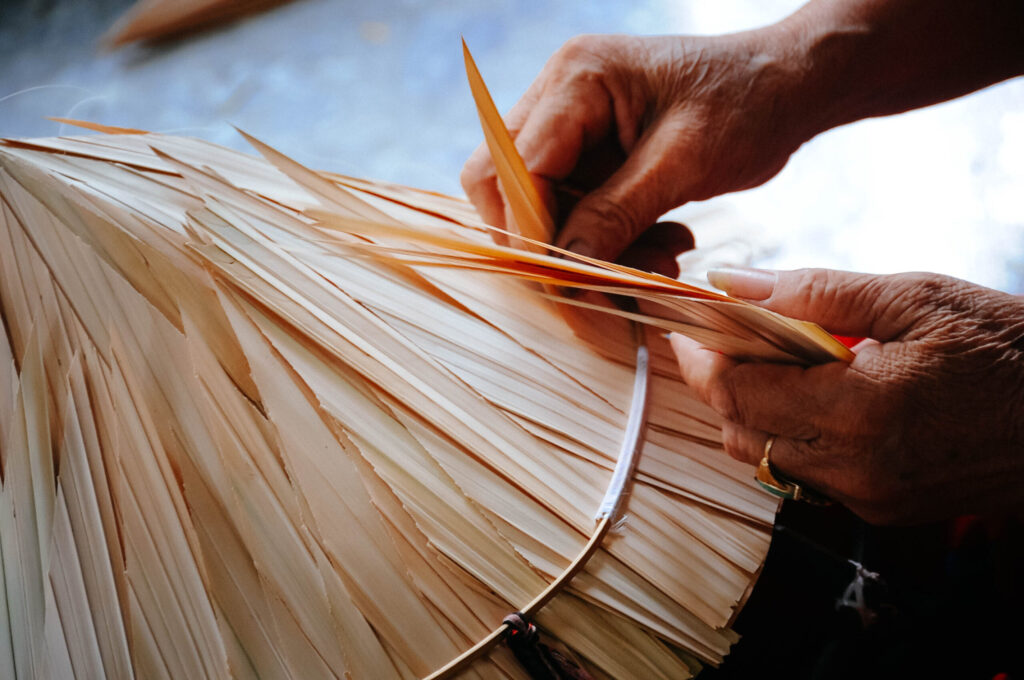
The process of making conical hats (Source: Internet)
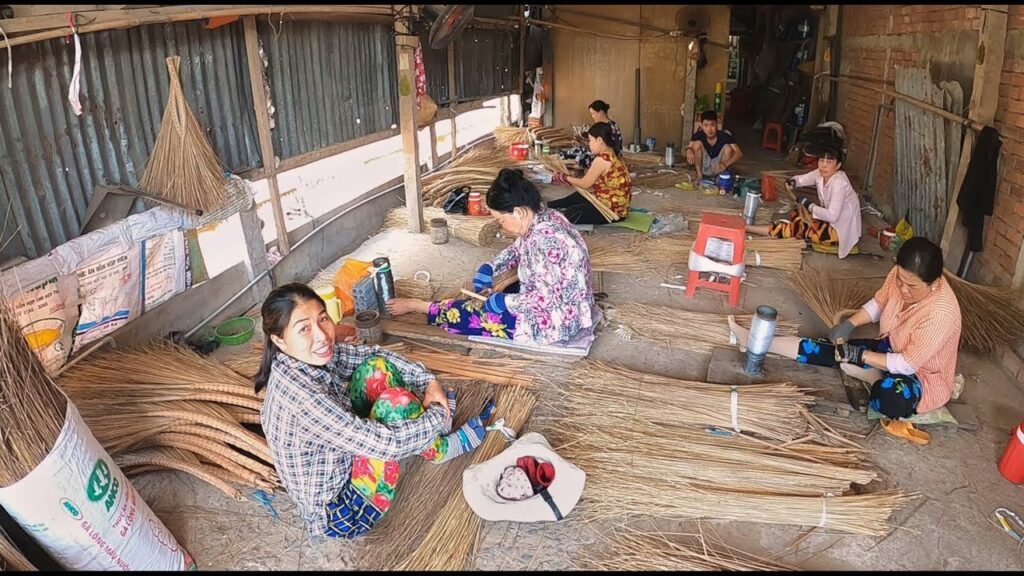
A prominent feature of the Hoi An craft village is the “stage specialization” among households. This means each family specializes in only a few steps of the process: some specialize in splitting bamboo, some only in ironing leaves, and others in layering and sewing the hats. The entire hat is the result of a hand-to-hand collaboration between many households in the village. This method utilizes the skills of each individual while creating a very distinct community rhythm for the handicraft village.
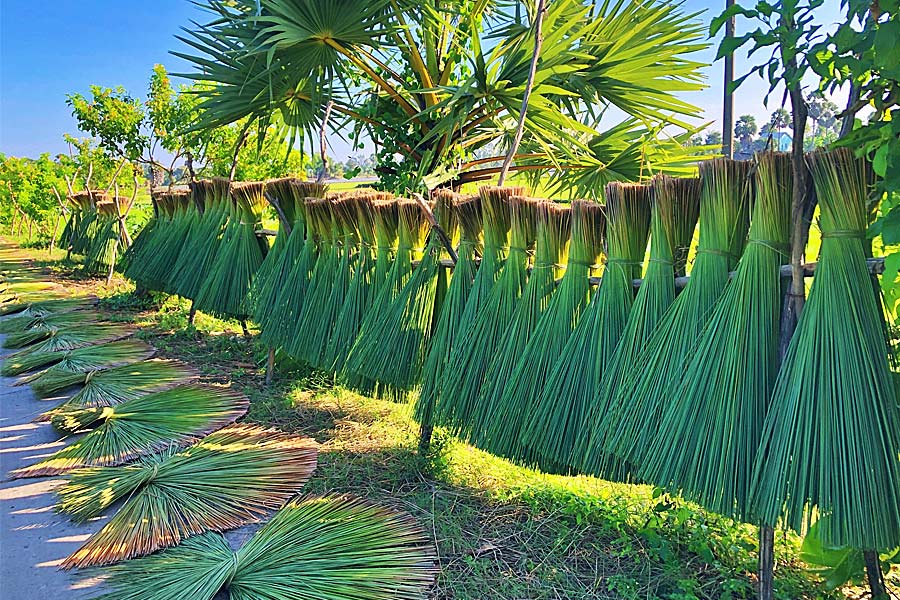
The leaves used for making hats are primarily fan palm leaves (lá buông), carefully selected from sources where the leaves are thick, durable, and shiny. Before being placed on the frame, the leaves must be dried just right and then ironed flat to prevent wrinkling. The hat frame is made of finely sharpened bamboo rings arranged in a preset mold. The artisan layers the leaves onto the frame evenly and tightly, then uses white thread to sew through each layer firmly yet gently and rhythmically.
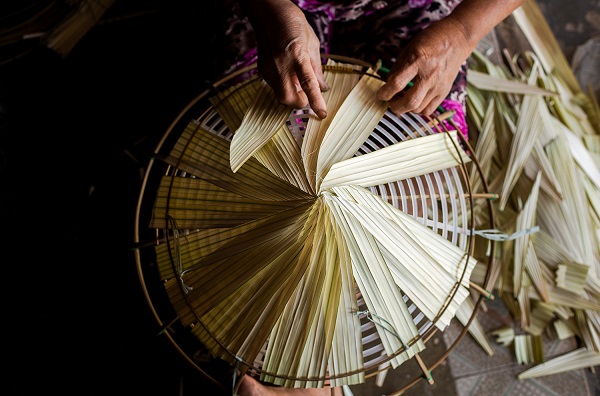
Molding the conical hat (Source: Internet)
Everything, from the arrangement of leaves to every needle stroke, is done by hand—no machines, no haste. A skilled artisan can only complete a few hats a day, depending on the complexity of the leaf layers and the design. But in every finished hat, one can clearly see the traces of time, care, and the silent pride of the maker.
The Value of the Hat Lies in the Maker’s Hands

Conical hats in Cho Moi, An Giang (Source: Internet)
A finished conical hat must go through more than 10 stages, from selecting leaves and splitting bamboo to molding, sewing every thread, and applying a glossy oil coat to ensure it is both durable and beautiful. Every detail requires meticulousness and a steady hand. Therefore, the value of the hat lies not only in its final shape but also in the time, patience, and skillful hands of the artisan.
The selling price of each hat in the Hoi An craft village ranges from 35,000 VND to 120,000 VND, depending on the thickness, the quality of the leaves, the level of sophistication, and decorative details like patterns or the glossy finish. On average, a maker can finish 4-6 hats per day, with a profit after deducting material costs of about 15,000 – 16,000 VND per hat. This figure might seem small, but for many rural women, it is a stable and regular source of income that helps them manage expenses during their spare time.
As shared by Ms. Tran Thi Dong (An Binh hamlet), besides working a few plots of rice fields, she sews hats whenever she is free. Completing a few hats each day allows her to save up a few tens of thousands of dong, which she can put into a piggy bank or use for unexpected expenses. To her, hat making is not just “extra work” but a way of life, a habit her hands cannot give up. Over the past three years, thanks to capital support from the Cooperative, she has been able to buy more materials and fulfill more orders, helping her family’s economy thrive. (Source: vtc2.vn)
The conical hat, which looks simple at first glance, contains the effort, perseverance, and heart of its maker. Each hat sold is not just a product but the result of a chain of meticulous manual labor—its true value cannot be measured by a small wage.
An Giang Craft Villages Facing the Wave of Modernization

Conical hats in the new era (Source: Internet)
In recent years, Hoi An commune, like many other rural areas in Cho Moi district, has been gradually changing with the new rhythm of life. Fewer young people are following the trade of hat making; some go to school, while others leave their hometown for the city to find more stable jobs. As a result, the craft is mainly left in the hands of older women who are still accustomed to the work and cannot bear to abandon it.
Making hats is inherently a handicraft that requires meticulousness and patience. The selling price is not high, yet the effort required is significant. The market is also not as easy as before, as the habit of using conical leaf hats is gradually being replaced by mass-produced products. Nevertheless, local people are still finding ways to adapt to the times.
Many households have started to approach new forms of selling: taking orders via phone, selling wholesale to tourist spots, and even combining custom-made hats for gifts, decorations, or performances and photography. Some who are familiar with social media also post for sale on Facebook and Zalo to reach a wider customer base. While these methods are still simple, they have opened up opportunities so that the craft is no longer confined within the village.
There is no longer the scene of every house bustling with the sound of sewing as in the past, but the craft has not disappeared. It is quietly changing—from the way it is made and sold to the way it exists—moving in a slower but more selective and hopeful direction.
Preserving the Craft – Preserving the Village’s Memory
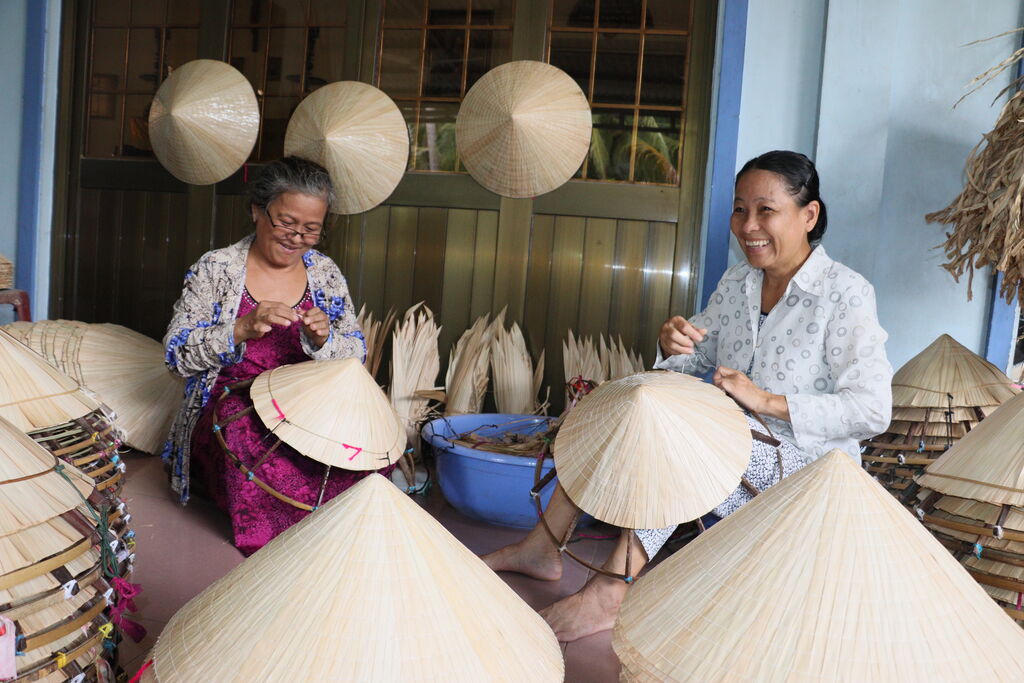
Preserving the traditional conical hat making craft (Source: Internet)
For many people in Hoi An commune, Cho Moi district, preserving the trade of conical hat making is not simply about keeping a job, but about holding onto a lifestyle that has become familiar over many generations. Each hat sold carries quiet memories: when a mother taught her daughter to hold a needle, when a grandmother sat rounding the hat rings on the porch, and when the whole neighborhood buzzed with conversation during every hat-making season.
Many elderly people in the commune are still dedicated to the craft, even though their children have stable jobs. They do it not for profit, but because their “hands would miss it too much to quit.” Someone jokingly said: “If I’m free and don’t touch the hat rings or the needle, my hands feel like they’re missing something.” That attachment is not easily explained by economic logic, but by a love for the old trade and a sense of self-respect for the honest labor they grew up with.
Preserving the craft is also about preserving a part of the village’s memory—a riverside land where people live slowly, persistently, and full of sentiment. Even though there are times when it is quiet, each hat is still born steadily like a piece of the countryside’s soul, remaining intact in every fiber of the leaf and every stitch of the thread.